The season
Summer — the dry
December to February, the tap shut and the ridge locked overhead — the season every plant and animal in the Adelaide region is built around surviving, and the one the fire trucks are built around too.
- On the gradient
- Not one site but the whole transect at once — the same closing act plays out from the samphire flats to the summit
Locate this place on the map →
What you'll take away
- Read summer's signature on the ground — cured-blond grass, cracked clay, a haze of fire-danger days — as the visible far side of the Mediterranean bargain, not simply 'hot weather.'
- Distinguish the two ways life crosses an Adelaide summer: sclerophyllous plants that keep working on a hoarded water budget, versus animals, geophytes and understorey that shut down, retreat to shade or go dormant until the rain returns.
- Explain why summer, specifically, is fire season here — cured fuel under the same blocking ridge, with hot dry winds ahead of a cool change — and read a scorched hillside three weeks on as a building site, not a graveyard.
- Connect one recorded extreme (Adelaide's hottest day on the books) and a hot-day tally to the ridge mechanism behind the whole season, rather than treating any single scorcher as a freak.
By December the green has already started leaving the year. Paddock grass that stood soft and blond-tipped in October cures to full straw within a few dry weeks, the clay under it shrinks and cracks into a crazy paving you can lose a finger into, and cicadas take over the soundtrack with a drone that only quits after dark. This is the season the rest of Adelaide’s ecology spends eleven months preparing for: the dry half of the Mediterranean bargain, when the subtropical ridge parks itself overhead and switches the rain off. It is not a gentle absence. Adelaide’s hottest recorded day arrived in the middle of it — 46.6°C at West Terrace on 24 January 2019 — and a run of days at or above 35°C, on the order of seventeen a year at the Airport, is the going rate for this stretch of the calendar rather than a series of exceptions.
Life crosses this gap two ways, and the difference is worth learning to see. One strategy is to keep working: the hard, small, leathery leaves of the local sclerophyll bush hoard water well enough to stay green and photosynthesising right through the drought, the same toughness independently invented on five continents wherever a climate sets this exact test (Cowling et al. 1996). The other is to stop: skinks and small mammals shift to the cool hours either side of noon, geophytes pull their whole above-ground selves back into a bulb or tuber underground, and the shadiest gullies fill up with everything that cannot bear the heat of the open ridge-top. Running on what it banked, or shutting down to wait — between those two answers is most of what is alive here in February.
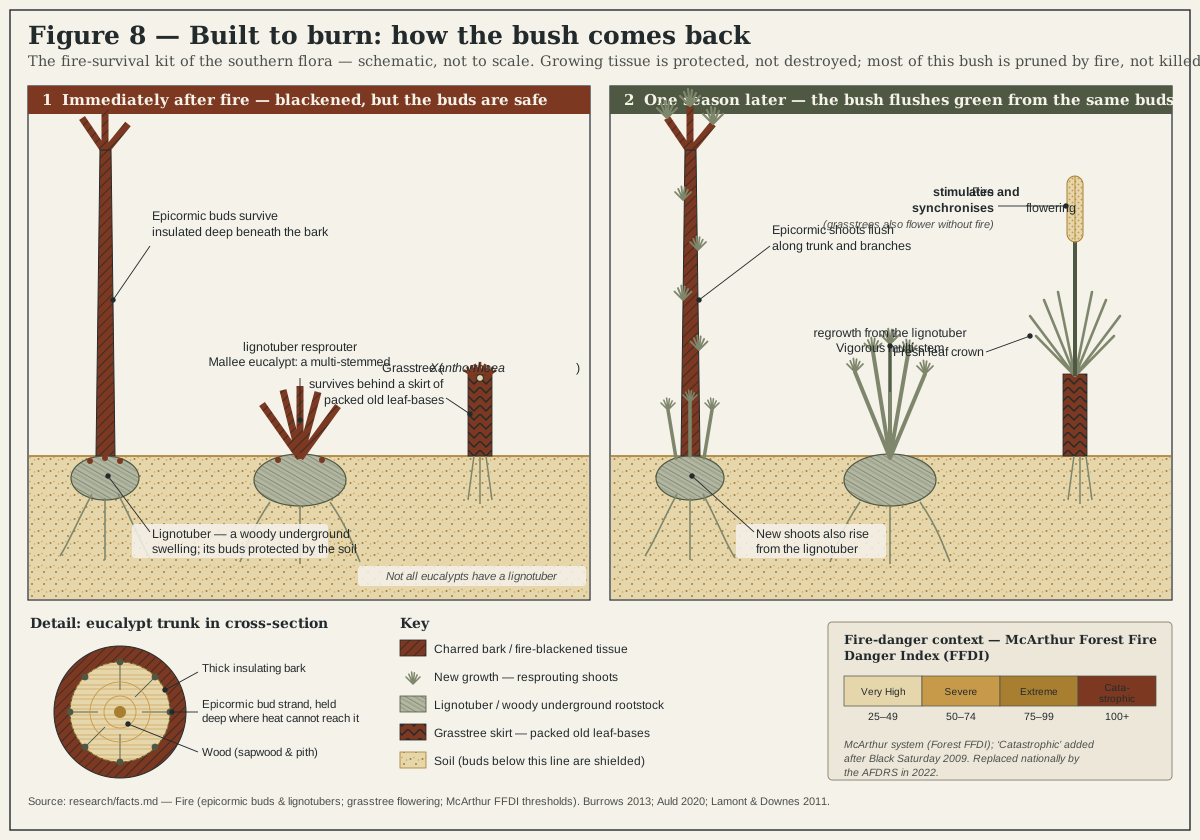
Summer is also fire season, and for the same reason it is drought season: cured grass and leaf litter, low humidity, and hot northerly winds that can precede a cool change by hours, all stacked under a climate that has always burned as part of its normal rhythm rather than as disaster (Keeley et al. 2012). Walk into a stringybark forest three weeks after such a fire and it looks finished — blackened trunks, a grey felt of ash — until the bark breaks out in green fuzz from buds that were waiting under it the whole time (Burrows 2013). That is the trick to reading an Adelaide summer honestly: the brown, the crack and the smoke are not the country failing. They are the test it has been rehearsing for since long before anyone kept a thermometer, and the readiness is written into practically everything green or breathing you can find.
Sources for this guide · 4
Every claim here is traceable. Each citation links to its entry in the bibliography.
- Cowling, R.M., Rundel, P.W., Lamont, B.B., Arroyo, M.K. & Arianoutsou, M. (1996). Plant diversity in mediterranean-climate regions. Trends in Ecology & Evolution 11(9):362-366. https://doi.org/10.1016/0169-5347(96)10044-6 — Sclerophylly and convergent evolution as the flora's answer to a rainless summer, shared across all five Mediterranean-climate regions.
- Keeley, J.E., Bond, W.J., Bradstock, R.A., Pausas, J.G. & Rundel, P.W. (2012). Fire in Mediterranean Ecosystems: Ecology, Evolution and Management. Cambridge University Press. — Fire as a normal, recurring feature of Mediterranean-climate ecosystems rather than an aberration, and its concentration in the dry season.
- Burrows, G.E. (2013). Buds, bushfires and resprouting in the eucalypts. Australian Journal of Botany 61(5):331-349. — Epicormic bud structure beneath eucalypt bark — the mechanism that lets the bush answer a summer fire within weeks.
- McKemey, M. et al. (2020). A review of contemporary Indigenous cultural fire management literature in southeast Australia. Fire 3(2): 27. (Preprint on EcoEvoRxiv.) https://ecoevorxiv.org/repository/object/4324/download/8665/ — Adelaide's hot-day tally (~17 days a year ≥35°C, Airport 1981–2010) — how much of the season this pattern actually claims.
Concepts this teaches — follow a thread
The Mediterranean bargain (two seasons, not four)The fire regimeHard leaves (sclerophylly)Built to burn
More guides like this
Test yourself →
Three weeks after a summer fire has torn through a Mount Lofty stringybark forest, the blackened trunks are breaking out in a fuzz of green leaves. What is actually going on?
Eucalypts carry dormant epicormic buds under their bark, and the bark itself is thick enough to insulate those buds from all but the hottest fires — so the green fuzz on a blackened trunk is the tree drawing on a structure it had ready long before the flames arrived, not a fresh start from seed. That is why recovery can show within weeks rather than the years a true seeder needs to re-establish from scratch (Burrows 2013). It is also why a scorched hillside three weeks on reads as a building site rather than a graveyard — the readiness was already built into the bark.