The season
Spring — the flowering
September to November, the ranges run their busiest machinery of the year at once — pea-flowers and ground orchids blooming, honeyeaters breeding on the nectar, ants banking next year's seed — before the summer tap shuts off.
- On the gradient
- The range front and Mount Lofty summit country, where the wet season's last flush plays out before the dry
- Rock
- Mount Lofty Ranges sclerophyll forest, woodland and heath on ancient, weathered bedrock
- Soil
- Poor, shallow, phosphorus-starved forest and heath soils typical of the range front and summit country
Locate this place on the map →
What you'll take away
- Explain why the region's spring flowering — native pea-flowers, ground orchids — is timed to the tail of the wet season, before summer drought shuts growth down.
- Connect the bloom to the nectar year: honeyeaters moving in, feeding and breeding while it lasts, then drifting away as it fades.
- Recognise that a ground orchid's spring flower rests on an invisible, obligate fungal partnership it cannot do without.
- Read a spring hillside as the sclerophyll cycle's busiest fortnight — flowering, pollination, breeding and seed-banking all crowded into one short window — in a landscape now cut into scraps too far apart for some birds to work.
By September the ranges are running a single, urgent piece of machinery flat out, and everyone in earshot knows it.
The golden run of wattle that opened the cool season is already thinning towards seed, but it hands the display straight on: the native pea-flowers — the yellow-and-red, unmistakably pea-shaped blooms of shrubby Fabaceae, packed thick through gully and heath — come into their own across spring, while down in the leaf litter the ground orchids push up their odd, solitary spikes, the drooping greenhoods and the cheerful donkey orchids flowering for a few weeks before vanishing back underground for the rest of the year.
Overhead a second machine is running to the same clock.
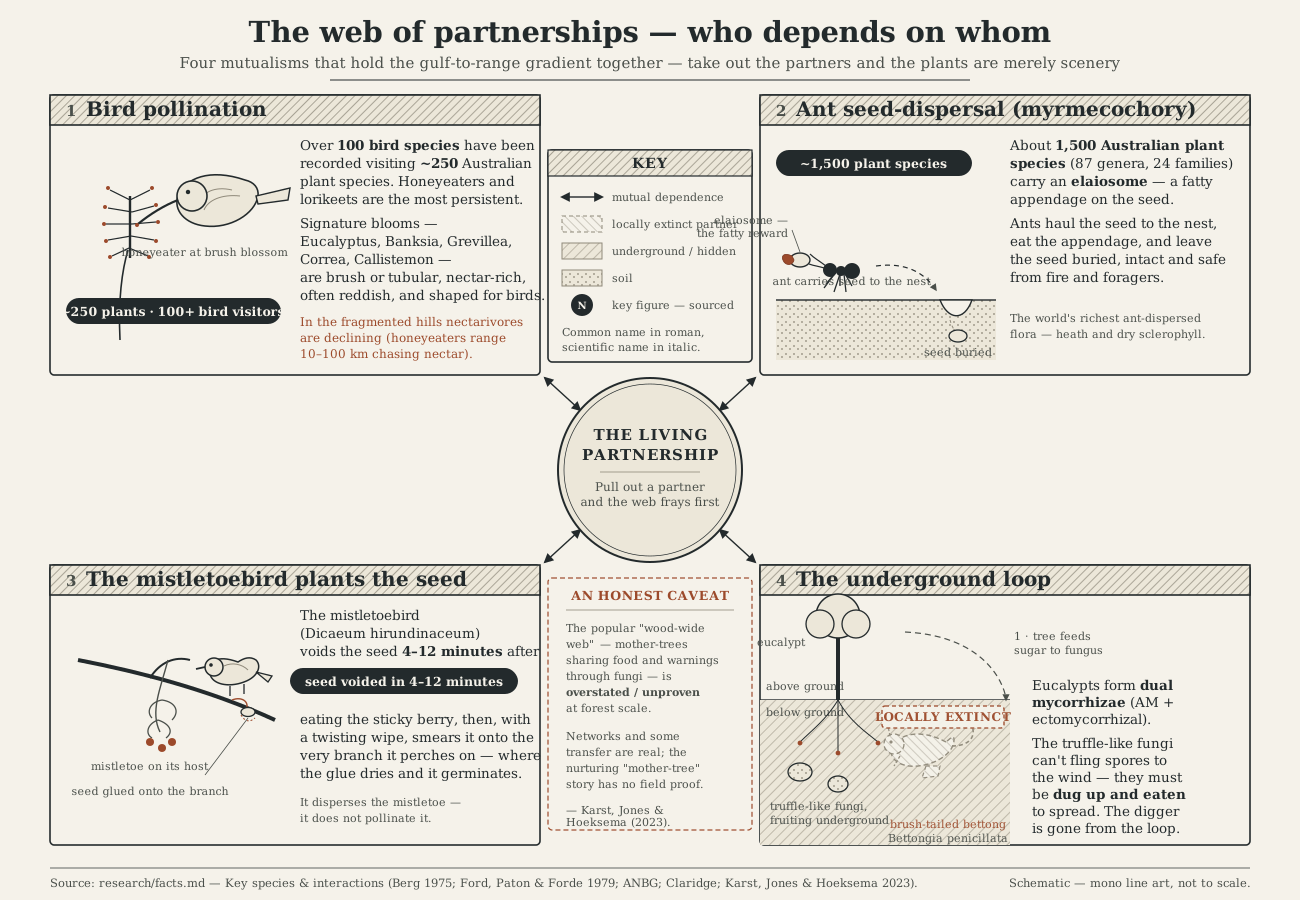
Nectar in the Mount Lofty region peaks in this window, the cool half of the year tipping into spring, and the honeyeaters follow it in — feeding, nesting and raising young while the bloom lasts, then drifting away again as the flowers close down for summer (Ford & Paton 1986).
It is not slack timing; a bird that bred to the wrong season would be raising chicks over an empty larder.
The orchids are running a stranger emergency, underground and out of season with everything else.
Each spike you see this spring exists at all only because, months earlier, a dust-fine seed with no food reserve of its own was found by one particular species of fungus and fed by it until it could grow a leaf — greenhoods pairing only with a fungus called Ceratobasidium, donkey orchids only with Tulasnella, a specificity worked out at Adelaide’s own Waite Institute (Warcup 1981).
Dig one up to save it, or scatter its seed on promising dirt without its fungus, and nothing will grow: the flower you are admiring is only ever half the plant.
And underfoot, the pea-flowers are already quietly banking next year’s business.
Many of the same Fabaceae shrubs producing this spring’s colour will, by summer, be shedding hard seed wearing a small fatty parcel built for exactly one customer — an ant, which will haul it underground, eat the bribe and leave the seed buried and planted, part of the roughly 1,500-species ant-sown flora that makes this bush the most heavily myrmecochorous on Earth (Berg 1975).
None of these three machines — flower and bird, orchid and fungus, seed and ant — was built to work together; each runs on the same brief wet-season clock.
Even at the hillside’s most exuberant, the woodland-bird community keeping this whole calendar honest has already lost some ten species to local extinction, with dozens more modelled to follow even if not another tree falls (Szabo et al. 2011) — which is why a loud, flowering spring is not proof that the machinery underneath it is still whole.
Go deeper — the mechanism & the evidence
The nectar year has more moving parts than a spring hillside lets on. Flowering concentrates on the region's poorer, better-drained soils rather than spreading evenly across the ranges, so honeyeaters do not sit and wait for the bloom to arrive — they track it, moving between flowering patches as the display shifts through the season, some covering tens of kilometres and occasionally as much as a hundred in a single circuit (Ford & Paton 1986). Breeding is timed to ride that movement: nesting starts as the nectar comes on and finishes before it fails, so a bird whose internal calendar drifted even a few weeks could end up feeding chicks into an empty landscape. That mobility is the system's whole design principle — no static population of insects could chase such a shifting resource the way a wide-ranging bird can — but it is also the vulnerability a fragmented Mount Lofty landscape now exploits. Roughly ten of the region's woodland-bird species are already regionally extinct, more than half of what remains is in decline, and a further 35–50 species are modelled to be lost from the ranges over time even without another hectare being cleared — an extinction debt accruing quietly beneath a display that, most years, still looks like abundance (Szabo et al. 2011).
Sources for this guide · 4
Every claim here is traceable. Each citation links to its entry in the bibliography.
- Ford, H.A. & Paton, D.C. (eds) (1986). The Dynamic Partnership: Birds and Plants in Southern Australia. Handbooks of the Flora and Fauna of South Australia. Adelaide: Government Printer. https://www.abebooks.com/book-search/title/dynamic-partnership-birds-plants-southern-australia/author/h-a-ford-d-c-paton/ — The nectar year — winter/spring flowering peak, and honeyeaters moving in to feed and breed while it lasts.
- Warcup, J.H. (1981). The mycorrhizal relationships of Australian orchids. New Phytologist 87(2):371-381. https://nph.onlinelibrary.wiley.com/doi/abs/10.1111/j.1469-8137.1981.tb03208.x — Ground orchids' genus-level fungal specificity, worked out at the Waite Institute.
- Berg, R.Y. (1975). Myrmecochorous plants in Australia and their dispersal by ants. Australian Journal of Botany 23(3):475-508. https://doi.org/10.1071/BT9750475 — Pea-flowers (Fabaceae) among the elaiosome-bearing genera of Australia's ant-sown flora.
- Szabo, J.K., Baxter, P.W.J., Vesk, P.A. & Possingham, H.P. (2011). Paying the extinction debt: woodland birds in the Mount Lofty Ranges, South Australia. Emu — Austral Ornithology 111(1): 59–70. DOI: 10.1071/MU09114. https://www.publish.csiro.au/mu/mu09114 — Mount Lofty woodland-bird decline and the modelled extinction debt behind the spring nectar economy.
Concepts this teaches — follow a thread
Birds that carry the pollenThe underground loopHard leaves (sclerophylly)
More guides like this
Test yourself →
You find a wild greenhood orchid flowering in the ranges this spring and, wanting more of them in your own garden, dig it up and replant it in good potting mix at home. Why does it almost certainly die rather than take?
Mount Lofty ground orchids germinate from a seed with no stored food, so the seedling only survives if it is found and fed by one specific fungal partner underground — greenhoods pairing with Ceratobasidium, donkey orchids with Tulasnella, a genus-level specificity worked out at Adelaide's Waite Institute. Move the plant without its fungus and you have moved only half of it. (Warcup 1981.)