A species · Mammal
Brush-tailed bettong (woylie)
A rabbit-sized digging kangaroo that once tilled the Adelaide Hills every night, sowing truffle-fungus spores as it went — gone from the whole mainland but for a handful of fenced sanctuaries, one lost gear in the underground loop.
- On the gradient
- The range-front and hills woodland — now readable only behind a predator-proof fence
- Rock
- Mount Lofty Ranges sclerophyll woodland over metamorphosed Adelaidean rock — the kind of country a fenced reintroduction site like Warrawong occupies
- Soil
- Sandy woodland loams, loosened nightly by digging where bettongs still persist
Locate this place on the map →
What you'll take away
- Identify what a bettong actually is — a small, digging rat-kangaroo, not a rat or a bandicoot — and its signature: a network of small conical diggings pockmarking the leaf litter.
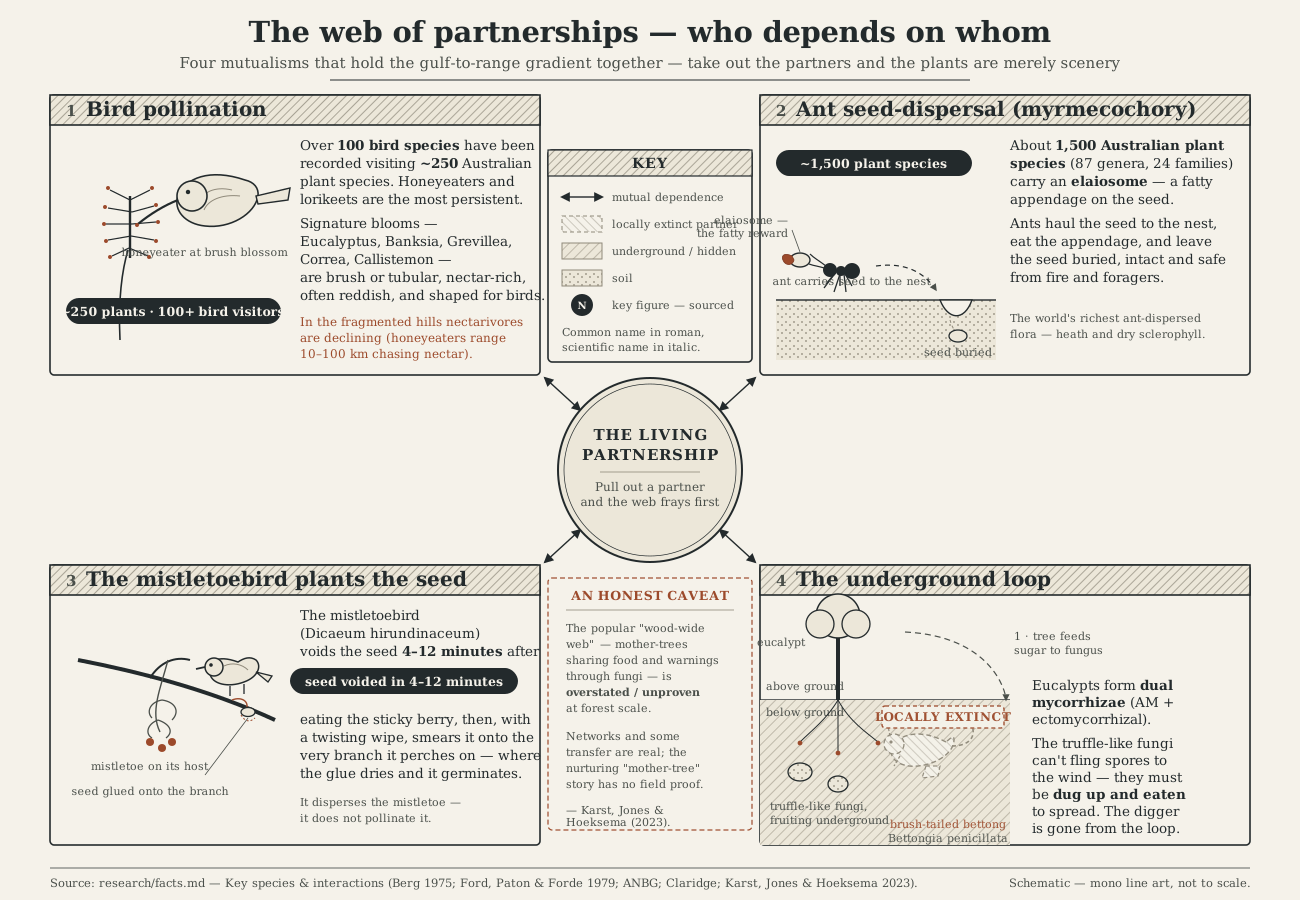
- Explain the mycorrhizal loop the bettong once powered: digging up hypogeous truffle-fungi, eating them, and re-sowing their spores across the ranges for the eucalypts that depend on those fungi.
- Read the bettong's absence on the Adelaide mainland as a diagnostic gap — a soil-turning, fungus-spreading gear missing from the machine, not just a lost animal — and know where the machine still runs, behind fences.
- Connect the loss to its cause: fox and cat predation on a mammal in exactly their preferred size range, compounded by altered fire regimes.
Most people, asked to picture a kangaroo, do not picture something you could fit in a shoebox.
But the brush-tailed bettong — the woylie, to use the name that travelled with it from further west — was exactly that: a rabbit-sized, hopping, digging marsupial with a curled prehensile tail for carrying nesting material, and a nose built for one job above all others, sniffing out fungus underground.
Every night of its working life it dug: small conical pits scattered through the leaf litter of the Adelaide Hills woodland, each one a place where the bettong had smelled a truffle and gone after it.
What it was digging up were not the truffles you’d pay a chef for, but a whole cast of native hypogeous, or underground-fruiting, fungi — Mesophellia, Hysterangium and their kin — that live in intimate partnership with eucalypt roots and, having given up on releasing spores to the wind the way a mushroom does, rely entirely on being dug up and eaten instead (Claridge 1994; Danks 2020).
The bettong ate the truffle, digested the flesh, and carried the spores onward in its gut, sowing a fresh dose of fungal partner into the soil at every stop — a service the eucalypts, and the whole community of plants leaning on the same fungal network, quietly depended on.
Fire, if anything, sharpened the job: in the one population where anyone has measured it — the Tasmanian bettong, a close relative studied after forest fires — digging activity rose roughly tenfold in the month after a burn, right when scorched, opened ground most needed reseeding (Johnson 1995).
On the Adelaide mainland, that machine has stopped.
The brush-tailed bettong is extinct across settled South Australia outside a handful of fenced refuges, one of the roughly thirty native mammal species the fox and the cat — let loose on a fauna with no defence against them — have erased from the mainland since the 1800s (Woinarski 2015).
You can still meet a living one, oddly, in the Adelaide Hills themselves: behind the predator-proof fence John Wamsley built at Warrawong, near Mylor, reintroduced bettongs have been digging their small conical pits again since the sanctuary reopened in 2019 (InDaily 2019) — a fenced-off rehearsal of a job the whole unfenced range once did for free.
Which is the honest way to read a bettong now: not as a curiosity behind wire, but as a gear you can hold in your hand and see exactly where it used to fit — turning soil, spreading fungus, feeding trees, on every hillside around the city, until it didn’t.
Go deeper — the mechanism & the evidence
The figure worth sitting with is Johnson's (1995): after fire moved through eucalypt forest, digging by the Tasmanian bettong rose roughly tenfold, peaking about a month after the burn. That is a Tasmanian bettong, Bettongia gaimardi — not the mainland woylie — because the mainland species is extinct outside fences and nobody can measure it in the wild here anymore. It stands in for what the Adelaide Hills population once did: fire opens the ground and thins the leaf litter, the truffle-fungi respond, and a healthy population of diggers should respond in turn, ploughing spores back into the freshly disturbed soil just when the fungi and their eucalypt partners need reseeding most. Claridge (1994) and Danks et al. (2020) supply the other half of the mechanism: hypogeous, truffle-like fungi such as Mesophellia, Hysterangium and Chondrogaster cannot fling spores to the wind the way a mushroom does, so they depend entirely on being smelled out, dug up and eaten — the spores pass through a marsupial gut and are deposited, still viable, wherever the animal next turns the soil. Remove the bettong and the loop does not stop cleanly; it degrades — fungi persist where they can still be found by whatever diggers remain (bandicoots, echidnas), but a fire-tuned, purpose-built disperser is missing from exactly the moment the system needs it most. It is a mechanism inferred from a related population, honestly labelled as such — which is the most this landscape currently allows.
Sources for this guide · 5
Every claim here is traceable. Each citation links to its entry in the bibliography.
- Claridge, A.W. et al. (1994). Mycophagy among Australian mammals. Australian Journal of Ecology 19. https://onlinelibrary.wiley.com/doi/abs/10.1111/j.1442-9993.1994.tb00489.x — Mycophagy among Australian mammals — bettongs and potoroos as major dispersers of truffle-fungus spores.
- Danks, M. et al. (2019/2020). Ectomycorrhizal fungal communities are dominated by mammalian dispersed truffle-like taxa in north-east Australian woodlands. Mycorrhiza 29. https://pubmed.ncbi.nlm.nih.gov/30895370/ — Truffle-like ectomycorrhizal fungi dominate eucalypt woodland fungal communities and mammal diets alike.
- Johnson, C.N. (1995). Interactions between fire, mycophagous mammals, and dispersal of ectomycorrhizal fungi in Eucalyptus forests. Oecologia. https://link.springer.com/article/10.1007/BF00341344 — Bettong digging (and so spore dispersal) rises sharply after fire — the fire-fungus-mammal link, measured in the Tasmanian bettong.
- InDaily (21 Aug 2019). Life reinstated to much-loved Warrawong Wildlife Sanctuary. https://www.indailysa.com.au/ — Warrawong Wildlife Sanctuary, Adelaide Hills — a fenced site holding reintroduced brush-tailed bettongs, reopened 2019.
- Woinarski, J.C.Z., Burbidge, A.A. & Harrison, P.L. (2015). Ongoing unravelling of a continental fauna: decline and extinction of Australian mammals since European settlement. PNAS 112(15):4531-4540. https://doi.org/10.1073/pnas.1417301112 — The predation-driven Australian mammal extinction wave the bettong belongs to.
Concepts this teaches — follow a thread
More guides like this
Adelaide rosellaBanksiaCommon brushtail possumGrasstree (Xanthorrhoea)Greater bilby (the lost suburbanite)Grey mangrove
Part of these pathways
Test yourself →
The brush-tailed bettong (woylie) is now extinct across the Adelaide Hills outside a few fenced sanctuaries. Every night of its working life, what underground partnership was it maintaining as it dug through the leaf litter?
Native hypogeous fungi such as Mesophellia and Hysterangium fruit underground and cannot release spores to the wind the way a mushroom does, so they depend entirely on being smelled out, dug up and eaten by mammals like the bettong; the spores pass through its gut and are deposited, still viable, wherever it next digs (Claridge 1994; Danks 2020). Losing the bettong does not stop the loop cleanly, but it removes a fire-tuned, purpose-built disperser from the system at exactly the moment recently burnt ground most needs reseeding.