A species · Plant
Grasstree (Xanthorrhoea)
A blackened, spear-topped tuft that looks half-dead most of its life and is in fact one of the toughest things in the bush — it shrugs off flame behind a skirt of its own old leaves, then answers the fire with a flowering spike.
- On the gradient
- Threaded through the range-front and Mount Lofty sclerophyll forest and woodland, from the hills scrub down into drier stringybark country
- Rock
- Deeply weathered, ancient, nutrient-poor soils of the Mount Lofty Ranges and their fringes
- Soil
- Old, phosphorus-starved sand and skeletal soils — sclerophyll country
Locate this place on the map →
What you'll take away
- Read the grasstree's black, skirted trunk correctly — as an insulating jacket of packed old leaf-bases, not fire damage or decay.
- Explain why a grasstree survives a fire that kills the shrub next to it, and why the same fire so often triggers a flowering spike the following season.
- Connect the grasstree to the wider fire-adaptation toolkit of the Mount Lofty bush, and to its role as a nectar source for honeyeaters and lorikeets.
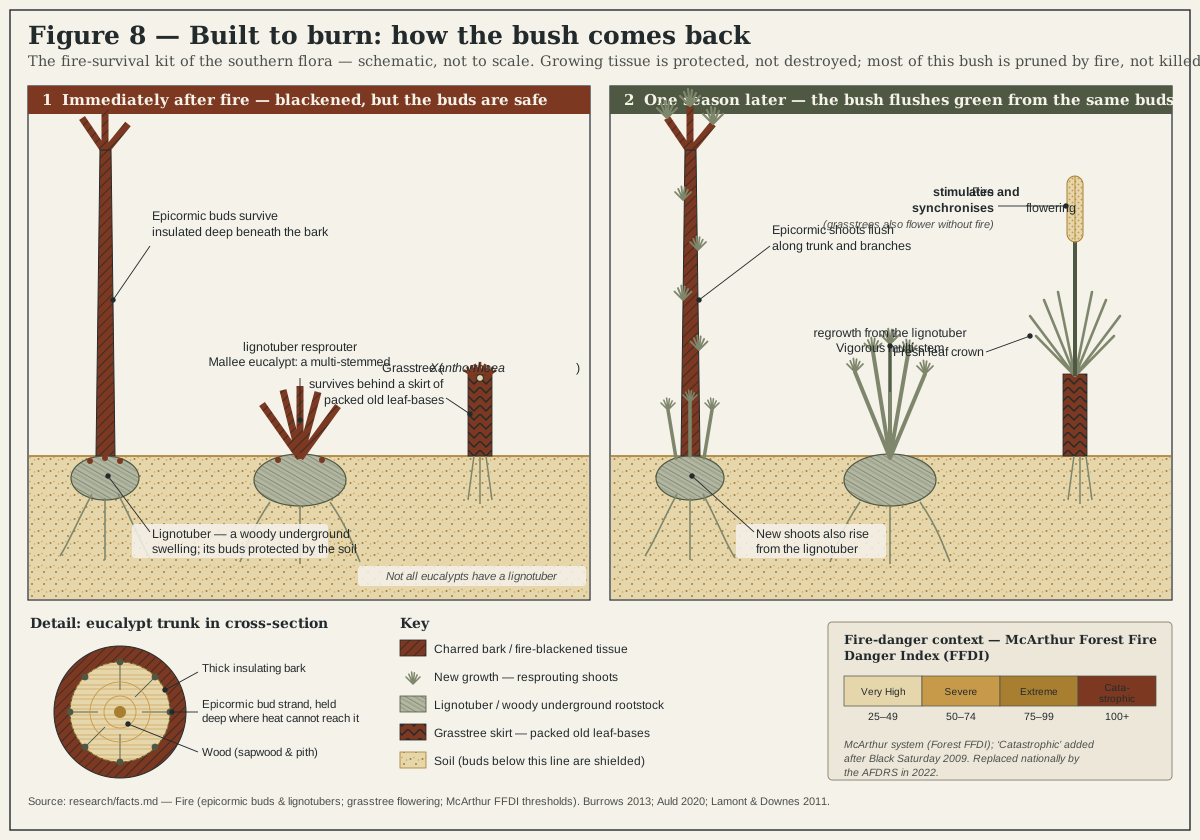
The old bush names for this plant were unkind — “blackboy,” for the charred trunk and the spear-straight flower spike some early settlers thought resembled a person — and the names have rightly fallen away, but the description behind them was not wrong. A mature grasstree does look burnt, more or less permanently, and that is very nearly the point. What looks like a scorched trunk is in fact a tightly packed jacket of the plant’s own dead leaf-bases, built up leaf by leaf over a lifetime and left in place rather than shed, the way a real tree sheds bark. It is a slow construction project: the grasstree’s woody-looking “trunk” is one of the slowest-growing structures in the Australian bush, so a specimen standing chest-high has been building that skirt for far longer than a casual glance would suggest.
That skirt is not decoration. It is fire-fighting equipment. When a bushfire comes through the Mount Lofty scrub, the dead thatch around a grasstree’s trunk goes up fast and fiercely, a torch of a plant seen from a distance. That is exactly what saves it. The blaze in the skirt burns hot but briefly, and it insulates the single growing point at the very centre of the crown, buried under all that char, from the heat that would otherwise kill it outright (Auld 2020). Walk past a stand of grasstrees a few weeks after a fire and you find them blackened to the ground and, at the crown, already pushing new grass-green leaves — one of the more startling resurrections in a forest full of them.
Then comes the reply. In the spring after a fire, grasstrees across a burnt hillside often throw up their flowering spikes together: a tall, single stem crowded with thousands of small cream flowers, sometimes standing taller than the plant that grew it. Fire does not force this: grasstrees flower in unburnt years, and plenty of them skip a season altogether. What fire does is synchronise the timing, so that the flowering response of a whole population is pulled into the same window (Lamont & Downes 2011). The result lands at exactly the right moment for everyone concerned — a mass nectar bar dropped onto fresh, ash-fertilised ground, at the one time the region’s honeyeaters and lorikeets, which work Xanthorrhoea flowers as reliably as they work eucalypts and banksias, can make the most of it (Ford, Paton & Forde 1979). A blackened hillside a year after a fire, spiked all over with pale flowering stems and loud with nectar-feeding birds, is one of the truest pictures the Mount Lofty Ranges can offer of what “built to burn” means.
Sources for this guide · 4
Every claim here is traceable. Each citation links to its entry in the bibliography.
- Auld, T.D. (2020). Fire and plants: how they recover. Australian Network for Plant Conservation. https://www.anpc.asn.au/wp-content/uploads/2020/01/Auld_Fire-and-plants_how-they-recover_-PDFv1a.pdf — Grasstree fire survival via the insulating leaf-base skirt, and fire-cued flowering as one of several post-fire recovery strategies.
- Lamont, B.B. & Downes, K.S. (2011). Fire-stimulated flowering among resprouters and geophytes in Australia and South Africa. Plant Ecology 212:2111-2125. https://doi.org/10.1007/s11258-011-9987-y — Fire-stimulated (not obligate) flowering timing in resprouters and geophytes, including the grasstree.
- Ford, H.A., Paton, D.C. & Forde, N. (1979). Birds as pollinators of Australian plants. New Zealand Journal of Botany 17(4):509-519. https://doi.org/10.1080/0028825X.1979.10432566 — Xanthorrhoea among the signature bird-pollinated genera worked by honeyeaters and lorikeets.
- Keeley, J.E., Bond, W.J., Bradstock, R.A., Pausas, J.G. & Rundel, P.W. (2012). Fire in Mediterranean Ecosystems: Ecology, Evolution and Management. Cambridge University Press. — Sclerophylly as a joint response to summer drought and the old, nutrient-poor soils grasstrees grow in.
Concepts this teaches — follow a thread
Built to burnHard leaves (sclerophylly)Birds that carry the pollen
More guides like this
Adelaide rosellaBanksiaBrush-tailed bettong (woylie)Common brushtail possumGreater bilby (the lost suburbanite)Grey mangrove
Part of these pathways
Test yourself →
A grasstree's trunk is wrapped in a thick, permanently blackened-looking skirt of old leaf bases. When a bushfire sweeps through the Mount Lofty scrub, that skirt goes up fast and fiercely — yet the grasstree usually survives while the shrub next to it is killed outright. Why?
The grasstree's 'trunk' is a lifetime's build-up of its own dead leaf-bases, packed tight rather than shed. That skirt burns hot and fast in a fire, but it burns as an insulating jacket around — not through to — the single growing point at the crown's centre, which is what lets the plant push new leaves within weeks while a neighbouring shrub with no such jacket is killed outright (Auld 2020).