A species · Plant
Banksia
A hard-leaved shrub that banks its seed in woody cones only a fire will open, and spends the interest on nectar for the region's honeyeaters — the drought-and-fire bargain in one plant.
- On the gradient
- Range-front heath and dry sclerophyll woodland, threaded through the Mount Lofty scrub from the hills down into stringybark country
- Rock
- Deeply weathered, ancient, nutrient-poor soils of the Mount Lofty Ranges and their sandy fringes
- Soil
- Old, phosphorus-starved sand and skeletal soils — classic sclerophyll country
Locate this place on the map →
What you'll take away
- Explain serotiny — why a banksia cone stays welded shut for years and opens only in a fire's heat — and read a woody, gaping old cone as the plant's seed bank, not a dead flower.
- Explain the bird-pollination bargain a banksia spike runs: a brush of hundreds of small flowers built for a honeyeater's face, trading nectar for pollen carried on to the next bush.
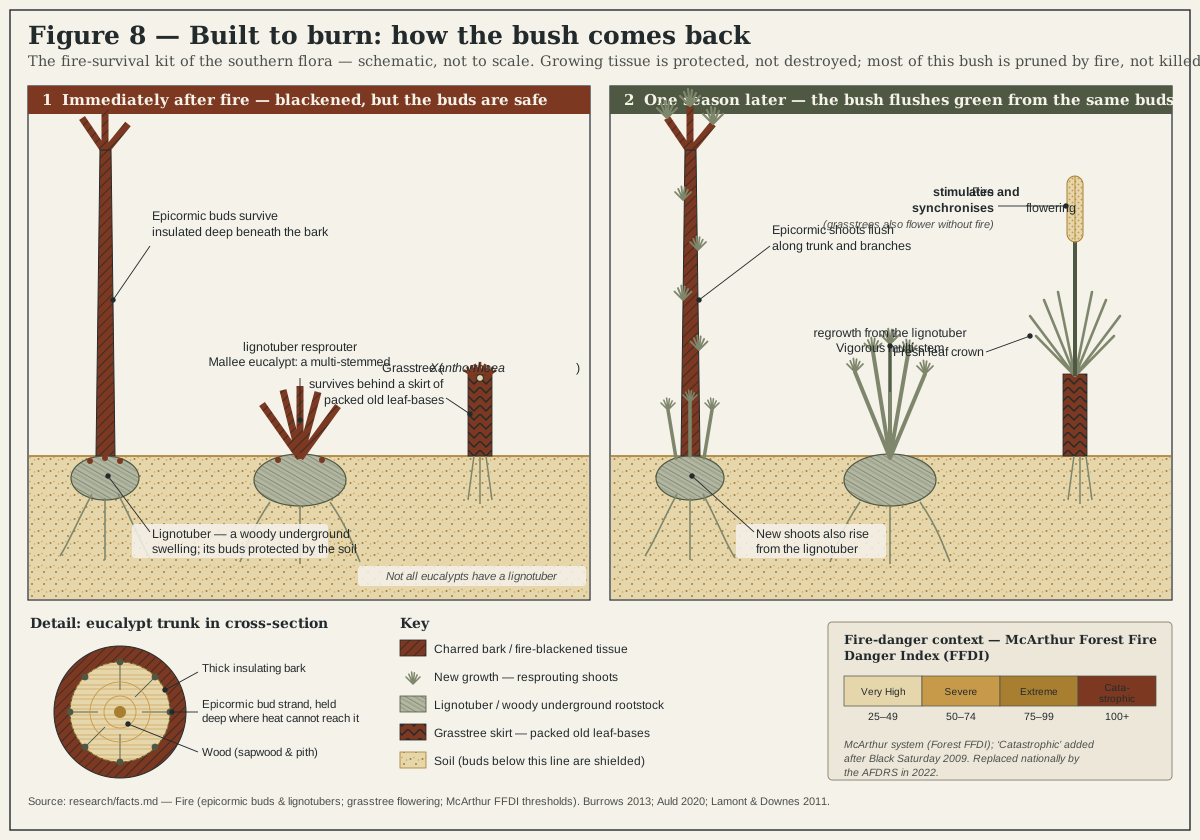
- Read the banksia's hard, leathery leaf as sclerophylly — the same drought-and-poor-soil economy that shapes the wider Mount Lofty bush — and connect a burnt banksia stand's flush of seedlings to the fire-adapted toolkit introduced elsewhere in the ranges.
Pick up an old banksia cone from the ground and you are holding a small act of patience. It is woody, grey, pocked all over with the ridged scars of hundreds of old flowers, and in places it has split into hard little beaks that gape but do not quite open — seed still locked inside, waiting. It may have been waiting for years. Banksias run one of the boldest bets in the fire-country repertoire: rather than release their seed as most plants do, on their own schedule, they weld it into a rock-hard cone and hold it there, sealed, sometimes for a decade or more, until a fire’s heat melts the resin binding the valves shut and springs them open (Auld 2020). The trick has a name — serotiny — and it is a signature move of fire-and-drought floras worldwide, the same wager chaparral and fynbos and maquis have each arrived at independently on the other Mediterranean-climate coasts of the planet (Cowling et al. 1996). The point of the wait is timing. A cone that opens in an ordinary year drops its seed onto ground already crowded with roots and shade and competition. A cone that opens in the days after a fire drops it onto bare, ash-fertilised soil, with every rival cleared away and full sun overhead — about as good a start as a seedling in this country ever gets.
Long before any of that, though, the same plant has already been paying its way in a different currency. A banksia’s flowering spike is not one flower but hundreds, packed tight in dense, brushy columns or domes, each tiny bloom holding its own thread of nectar — a design built, as plainly as a flower can be built for anything, to be visited by a bird’s face (Ford, Paton & Forde 1979). Honeyeaters work a flowering banksia hard, plunging bill-deep for the sugar-water and picking up a dusting of pollen each time they do, which travels, entirely by accident, to the next spike along. In the Adelaide region that traffic follows a season: banksia and its heath-country neighbours tend to flower through the cooler months, when the honeyeaters that depend on them are ranging widest to find a paddock still in bloom (Ford & Paton 1986). A banksia in flower on a winter morning, humming with wattlebirds and New Holland honeyeaters, is that whole economy in session.
The leaves that frame all this are doing their own quiet work. Stiff, leathery, often serrated along a hard, waxy edge, they are built to a common southern-Australian recipe — sclerophylly — that answers two problems at once: a summer with no reliable rain, and a soil so old and leached of phosphorus that growing a soft, cheap leaf is a luxury few plants here can afford. Put the two halves of the banksia’s life together and the plant reads as a small, self-contained lesson in the region’s rules. It banks its capital in a fireproof vault, spends its nectar income on a partnership with birds, and wears leaves cut for drought and poverty rather than comfort — and when the fire finally comes through, as sooner or later around Adelaide it always does, the vault springs open and the whole account is paid out onto the ash at once.
Sources for this guide · 4
Every claim here is traceable. Each citation links to its entry in the bibliography.
- Auld, T.D. (2020). Fire and plants: how they recover. Australian Network for Plant Conservation. https://www.anpc.asn.au/wp-content/uploads/2020/01/Auld_Fire-and-plants_how-they-recover_-PDFv1a.pdf — Serotiny (fire-cracked woody cones) as a distinct fire-recovery strategy alongside resprouting and smoke-cued germination.
- Cowling, R.M., Rundel, P.W., Lamont, B.B., Arroyo, M.K. & Arianoutsou, M. (1996). Plant diversity in mediterranean-climate regions. Trends in Ecology & Evolution 11(9):362-366. https://doi.org/10.1016/0169-5347(96)10044-6 — Serotiny as one of the convergent fire-survival traits shared across the world's Mediterranean-climate floras.
- Ford, H.A., Paton, D.C. & Forde, N. (1979). Birds as pollinators of Australian plants. New Zealand Journal of Botany 17(4):509-519. https://doi.org/10.1080/0028825X.1979.10432566 — Banksia among the signature bird-pollinated genera, and the mechanics of the brush-flower/honeyeater bargain.
- Ford, H.A. & Paton, D.C. (eds) (1986). The Dynamic Partnership: Birds and Plants in Southern Australia. Handbooks of the Flora and Fauna of South Australia. Adelaide: Government Printer. https://www.abebooks.com/book-search/title/dynamic-partnership-birds-plants-southern-australia/author/h-a-ford-d-c-paton/ — The Adelaide-region nectar year and honeyeater movement that a flowering banksia feeds into.
Concepts this teaches — follow a thread
Built to burnBirds that carry the pollenHard leaves (sclerophylly)
More guides like this
Adelaide rosellaBrush-tailed bettong (woylie)Common brushtail possumGrasstree (Xanthorrhoea)Greater bilby (the lost suburbanite)Grey mangrove
Part of these pathways
Test yourself →
You find an old banksia cone on the ground: woody, grey, and split in places into hard little beaks that gape but have not fully opened, with seed still visible locked inside. Why does a banksia cone hold its seed sealed like this for years rather than releasing it straight away, as most plants do?
This is serotiny: the cone is welded shut by resin and can hold seed for a decade or more, opening only when a fire's heat melts that seal (Auld 2020). The payoff is timing rather than storage for its own sake — a cone that opens after fire drops its seed onto bare, ash-fertilised soil with rivals cleared away, instead of into an already-crowded, shaded understorey. Serotiny is not a banksia quirk; it is a convergent strategy that chaparral, fynbos and maquis have each evolved independently on the world's other Mediterranean-climate coasts (Cowling et al. 1996).