An ecosystem
Stringybark country
The forested spine of the Mount Lofty Ranges — a wet island of the past, marooned by drought and holding on, that is quietly emptying of its woodland birds.
- On the gradient
- The wet spine — high-rainfall forested ranges above the cleared plains and below the deepest gully refuges
- Rock
- Uplifted, deeply weathered Neoproterozoic (Adelaidean) bedrock along the Mount Lofty Ranges scarp block
- Soil
- Leached, acid duplex soils (Kurosols) on the high, wet ranges
Locate this place on the map →
What you'll take away
- Explain why forest still stands on the Mount Lofty Ranges when almost none survives on the plains — read it as a mesic refugium, an island of high rainfall marooned in a drying land, not just steep or stony ground spared the plough.
- Recognise the stringybarks (messmate Eucalyptus obliqua, brown stringybark E. baxteri) as a disjunct population — outliers of wetter eastern Australia, stranded here as the continent dried around them.
- Read a stringybark forest's thinning birdsong as a live extinction debt: a woodland that still looks intact but whose bird species are already committed to disappearing as the cleared, fragmented land around it closes in.
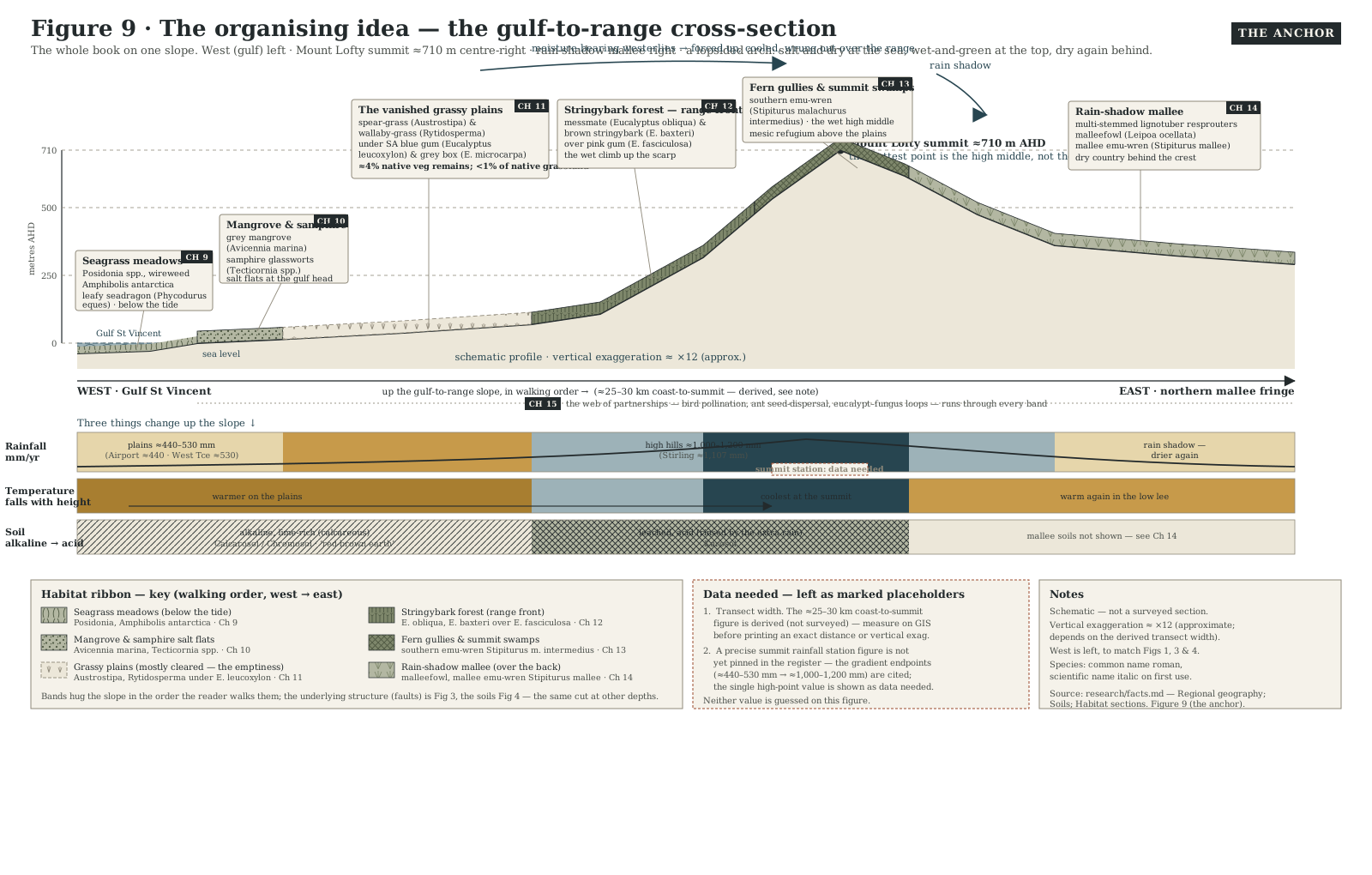
Climb out of the cleared plain onto the fault scarp and, suddenly, there is forest again — tall, closed-canopy, and older than almost everything growing below it. This is stringybark country, the wooded spine of the Mount Lofty Ranges, and the reason it still stands where the plains do not is only half about steepness and stone. The deeper reason is rain. The high ranges wring something like a thousand millimetres of westerly rain a year from the sky, more than twice what falls on the coast fifteen kilometres downhill (Armstrong 2003). That extra water builds a cool, moist island — ecologists call it a mesic refugium — marooned in one of the driest corners of the continent, and it is why any forest survives here at all.
The trees that give the place its name make the point best. Messmate (Eucalyptus obliqua) and brown stringybark (E. baxteri), the shaggy-barked eucalypts that roof these hills, belong by rights to the wetter forests of eastern Australia, hundreds of kilometres away. The Mount Lofty stands are a disjunct outlier of that range, cut off by a belt of country too dry for a stringybark seedling to cross, holding on here in a hotter, more summer-arid niche than their eastern relatives will tolerate (Guerin et al. 2023). Every stringybark you stand under is a small, legible clue that the wet forest once reached much further than it does now.
Stand still on a spring morning, though, and the refuge sounds thinner than it looks. Sixteen years of careful monitoring found more than half the ranges’ woodland bird species in decline, some of them steeply (Prowse et al. 2021). Cleared to roughly a tenth of its original extent since 1836 and left standing mostly as fragments, the forest is paying out what ecologists call an extinction debt: species not gone yet, but already committed to disappearing as the patches that hold them prove too small and too isolated to keep a breeding population going (Szabo et al. 2011). About ten of the ranges’ woodland birds are already gone; the survivors are living on borrowed time in a landscape whose account was opened the day the first paddock was cleared.
And the refuge itself is fraying at the edges. In the droughts of 2006–2009 and 2018–2019, whole hillsides of stringybark browned and died back, worst along the hotter, drier northern margins of the ranges, with a root pathogen finishing what the heat began (Guerin et al. 2023). A mesic refugium only works for as long as it stays mesic. Stringybark country is the gradient’s great survivor — and, in its thinning birdsong and its browning ridgelines, its starkest warning.
Go deeper — the mechanism & the evidence
The Mount Lofty stringybark forest is a doubly precarious refuge, worn down from two directions at once. Land clearing has already reduced the ranges' original woodland to roughly a tenth of its extent - cleared outright, modified, or cut into fragments (Szabo et al. 2011). Modelling that fragmentation forward, Szabo and colleagues estimate a further 35-50 woodland bird species are effectively already committed to eventual regional loss, on top of the roughly ten already gone - a debt not yet paid in full. Layered onto that fragmentation is a drying climate acting directly on the trees themselves: severe droughts in 2006-2009 and 2018-2019 triggered stringybark dieback across the ranges, worst on the hotter, drier northern and range-edge sites, with the soil pathogen Phytophthora implicated as a secondary driver where dieback ran deepest (Guerin et al. 2023). Sixteen years of standardised bird surveys confirm the trend is real and ongoing: 38 of 65 monitored woodland species are declining, a pattern robust enough to survive the usual noise of year-to-year variation (Prowse et al. 2021). Two slow pressures, clearing and drying, are converging on the same narrow strip of forest.
Sources for this guide · 4
Every claim here is traceable. Each citation links to its entry in the bibliography.
- Armstrong, D.M., Croft, S.J. & Foulkes, J.N. (2003). A Biological Survey of the Southern Mount Lofty Ranges, South Australia, 2000–2001. Department for Environment and Heritage, South Australia. https://data.environment.sa.gov.au/Content/Publications/Southern-Mount-Lofty-Ranges-BioSurvey.pdf — Biological survey of the southern Mount Lofty Ranges — the rainfall gradient and refuge biota.
- Guerin, G.R., Keppel, G., Peters, S. & Hurren, A. (2023). Dieback of stringybark eucalypt forests in the Mount Lofty Ranges. Transactions of the Royal Society of South Australia 147(1): 17–38. DOI: 10.1080/03721426.2023.2200875. https://doi.org/10.1080/03721426.2023.2200875 — Stringybark disjunction, summer-arid niche, and 2006-09/2018-19 drought dieback.
- Szabo, J.K., Baxter, P.W.J., Vesk, P.A. & Possingham, H.P. (2011). Paying the extinction debt: woodland birds in the Mount Lofty Ranges, South Australia. Emu — Austral Ornithology 111(1): 59–70. DOI: 10.1071/MU09114. https://www.publish.csiro.au/mu/mu09114 — Woodland clearance/fragmentation figures and the Mount Lofty extinction-debt modelling.
- Prowse, T.A.A., O'Connor, P.J., Collard, S.J., Rogers, D.J. & Litchfield, C. (2021). Optimising monitoring for trend detection after 16 years of woodland-bird surveys. Journal of Applied Ecology 58(6): 1090–1100. (Author list to confirm.) DOI: 10.1111/1365-2664.13860. https://doi.org/10.1111/1365-2664.13860 — Sixteen years of woodland-bird monitoring confirming ongoing decline.
Concepts this teaches — follow a thread
The mesic refugium (a wet island in a dry land)Disjunction (stranded on a wet island)The extinction debt
More guides like this
The fern gulliesThe Fleurieu peat swampsThe rain-shadow malleeThe seagrass meadowsThe vanished grassy plains
Part of these pathways
The gradient (for students)The wet islandThe whole gradient — gulf to summit
Test yourself →
You climb out of the cleared Adelaide Plains onto the Mount Lofty fault scarp and, quite suddenly, tall closed-canopy forest closes over the road. The trunks are shaggy, fibrous-barked eucalypts unlike anything on the plain below, the air feels noticeably cooler and damper, and on this spring morning the birdsong seems thin for a forest this size. Here and there a hillside shows a patch of browned, dead-looking canopy among the green. Which of the region's worlds are you standing in?
Cues: Tall, closed-canopy forest appearing abruptly on the range scarp above the cleared plain · Shaggy, fibrous-barked eucalypts unlike anything on the plain below · Noticeably cooler, damper air than the plain fifteen kilometres downhill · Spring birdsong that sounds thin for the size of the forest · Patches of browned, dieback-killed canopy on the hotter, drier hillsides
Every cue points to the wooded spine of the ranges rather than anywhere else on the gulf-to-range gradient: the sudden closed canopy and shaggy-barked messmate and brown stringybark mark a mesic refugium, wrung from westerly rain that runs to roughly 1000 mm a year on the high ranges, more than twice the coastal plain's total (Armstrong et al. 2003). The thin birdsong is the audible edge of an extinction debt — more than half the ranges' monitored woodland bird species are in decline after clearing left only about a tenth of the original forest standing (Szabo et al. 2011; Prowse et al. 2021) — and the browned hillside patches are drought dieback, worst on the hotter, drier range margins (Guerin et al. 2023). Samphire, mallee and plains woodland each sit elsewhere on the gradient and share none of these signs.