A force
The drought engine
A belt of high pressure that parks over Adelaide every summer and slides away every winter — the Mediterranean bargain of wet-winter, killing-dry-summer that every living thing here is built to survive.
- On the gradient
- Not a single site but the citywide rule — the climate engine that runs above the whole gulf-to-range transect
Locate this place on the map →
What you'll take away
- Explain the subtropical ridge mechanism — why Adelaide's dry season falls in summer, when the sun is highest, rather than in winter.
- State how rare a Mediterranean climate is (five small regions worldwide) and the outsized share of the planet's plant diversity those regions hold between them.
- Connect the drought engine to sclerophylly and convergent evolution — why hardship, given deep time, breeds toughness and variety rather than bare ground.
- Read Goyder's Line as this same climate rule made visible on a map, and recognise it as a line already sliding under a warming, drying climate.
Adelaide, like the real Mediterranean, gives up on four seasons and settles for two: a mild, wet winter, and a long, rainless summer that can turn lethal. On 24 January 2019 West Terrace hit 46.6°C, Adelaide’s hottest day on record — then the wind swung off the sea and the temperature fell fifteen degrees within the hour. Furnace one hour, cardigan the next: not a freak, but this landscape’s engine running in the open.
The mechanism is an atmospheric traffic jam called the subtropical ridge, a belt of high pressure girdling the planet at around 30° latitude and building most of the world’s deserts. In summer it parks over southern Australia; descending air makes clear skies, barring the door to any relieving front. In winter it slides north, the door opens, and Southern Ocean fronts march in on the “roaring forties,” bringing Adelaide’s rain with them. That is a Mediterranean climate.
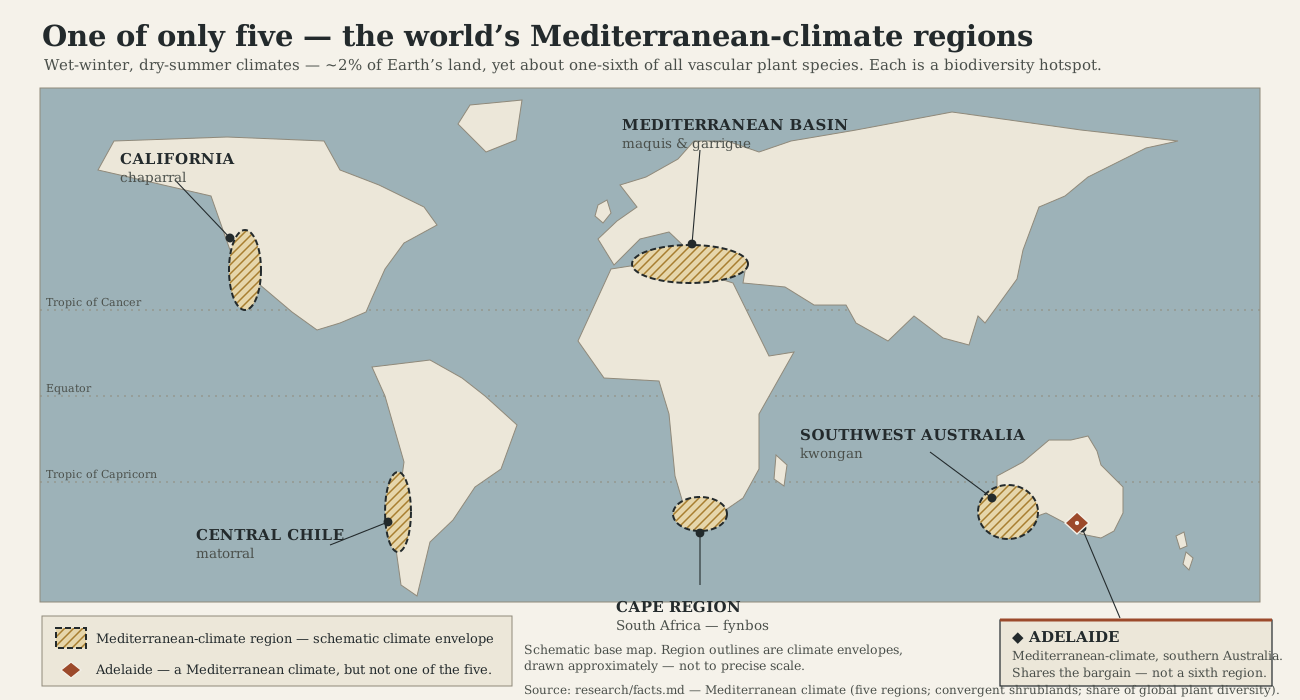
Only five small patches of Earth run their seasons this way: the Mediterranean basin, coastal California, central Chile, the Cape of South Africa, and southern/south-western Australia, of which Adelaide sits at the eastern edge. Together they cover under two per cent of the planet’s land, yet hold something like a sixth of its plant species (Cowling et al. 1996). No accident: guaranteed drought, then fire, is a brutal filter that, given deep time, breeds invention rather than bare ground. Unrelated floras converged on one toolkit — stiff, evergreen leaves that hoard water; buds under bark; seed locked in fruit only flame cracks; germination held until the seed tastes smoke (Keeley et al. 2012) — each assembling its version separately (Rundel et al. 2016), so the grey-green heath on the range front sat the same exam as the fynbos and chaparral.
The bargain has a hard edge. In 1865, after a ruinous drought, Surveyor-General George Goyder drew a line between reliable cropping country and country fit only to graze — reading the vegetation, not a rain gauge, marking where good grass gave out and saltbush took over (Goyder 1865). Goyder’s Line is the drought engine made visible on a map, and it was ignored within a decade: wet years lured wheat farmers north on “rain follows the plough,” and the returning dry collected what it was owed, leaving roofless stone farmhouses standing north of the Line to this day.
Everything downstream — hard leaves, fire scars on a stringybark trunk, the saltbush boundary itself — replies to this one belt of high pressure. Read the drought engine first, and the gradient stops looking like a list of facts and starts looking like one argument, restated in leaf, flame and line.
Sources for this guide · 4
Every claim here is traceable. Each citation links to its entry in the bibliography.
- Cowling, R.M., Rundel, P.W., Lamont, B.B., Arroyo, M.K. & Arianoutsou, M. (1996). Plant diversity in mediterranean-climate regions. Trends in Ecology & Evolution 11(9):362-366. https://doi.org/10.1016/0169-5347(96)10044-6 — Five Mediterranean-climate regions, under 2% of Earth's land, holding a disproportionate share of global plant diversity.
- Rundel, P.W., Arroyo, M.T.K., Cowling, R.M., Keeley, J.E., Lamont, B.B. & Vargas, P. (2016). Mediterranean Biomes: Evolution of Their Vegetation, Floras, and Climate. Annual Review of Ecology, Evolution, and Systematics 47:383-407. https://doi.org/10.1146/annurev-ecolsys-121415-032330 — Independent, region-by-region evolution of Mediterranean vegetation and flora.
- Keeley, J.E., Bond, W.J., Bradstock, R.A., Pausas, J.G. & Rundel, P.W. (2012). Fire in Mediterranean Ecosystems: Ecology, Evolution and Management. Cambridge University Press. — Fire and drought as the shared selective force behind sclerophyll shrubland.
- Goyder's Line. SA History Hub (History Trust of South Australia); primary artefact: Goyder's 1865 hand-drawn map, State Library of South Australia. https://sahistoryhub.history.sa.gov.au/subjects/goyders-line/ — Goyder's 1865 survey of the reliable-rainfall boundary — the drought engine read from the vegetation.
Concepts this teaches — follow a thread
The Mediterranean bargain (two seasons, not four)The same answer, five timesHard leaves (sclerophylly)Goyder's Line (where the saltbush begins)
More guides like this
Test yourself →
Adelaide's rain falls almost entirely in winter, and its driest, most dangerous season is summer — the opposite of what you'd expect if temperature alone controlled rainfall. What actually turns the tap off in summer and back on in winter?
The subtropical ridge is a girdle of high pressure at around 30° latitude — the same belt that builds most of the world's deserts. In summer it settles over southern Australia; descending air keeps skies clear and bars the door to any relieving front. In winter it slides north, opening the door to Southern Ocean fronts riding the 'roaring forties,' which bring Adelaide's rain. Only five small regions on Earth run their seasons this way, together covering under two per cent of the planet's land yet holding something like a sixth of its plant species (Cowling et al. 1996).