A force
Fire country
The third force of the Adelaide summer — a country the bush was built to burn, that answers flame with a resurrection kit of its own, and that a crowded, warming range front is still learning how much of, and whose hand should light.
- On the gradient
- Concentrated in the fuel-heavy Mount Lofty range front, but a force that reaches the whole gulf-to-range transect every summer
- Rock
- Range-front sclerophyll forest and woodland over the fault-lifted Mount Lofty Ranges
- Soil
- Old, nutrient-poor sclerophyll soils that also bank the heaviest fuel loads
Locate this place on the map →
What you'll take away
- Explain why fire is a normal, expected event in Adelaide's Mediterranean climate rather than an outside calamity, and name the two mechanisms — epicormic resprouting and the lignotuber — that let the local bush answer it.
- Describe the suppression paradox: why stopping every fire does not remove the risk but banks it as fuel, and why land managers now reintroduce fire deliberately through cool-season prescribed burning.
- Connect the modern Mount Lofty fire regime to its deliberately managed pre-1836 history, and to the still-open question — too much fire versus too little, and whose hand lights it — that both land managers and the returning practice of Kaurna cultural burning are answering in different ways.
Every fire-adapted country has a day people remember by name, and Adelaide’s is Ash Wednesday, 1983 — a savage, drought-fed firestorm out of the Adelaide Hills that still shapes how the city thinks about flame: an intruder, a calamity visited from outside the green world. That reflex is nearly backwards. Fire is not a visitor here. It is a resident, as much a part of the deal as the winter rain and the killing-dry summer, and most of what grows around Adelaide has spent millions of years learning to turn it to account.
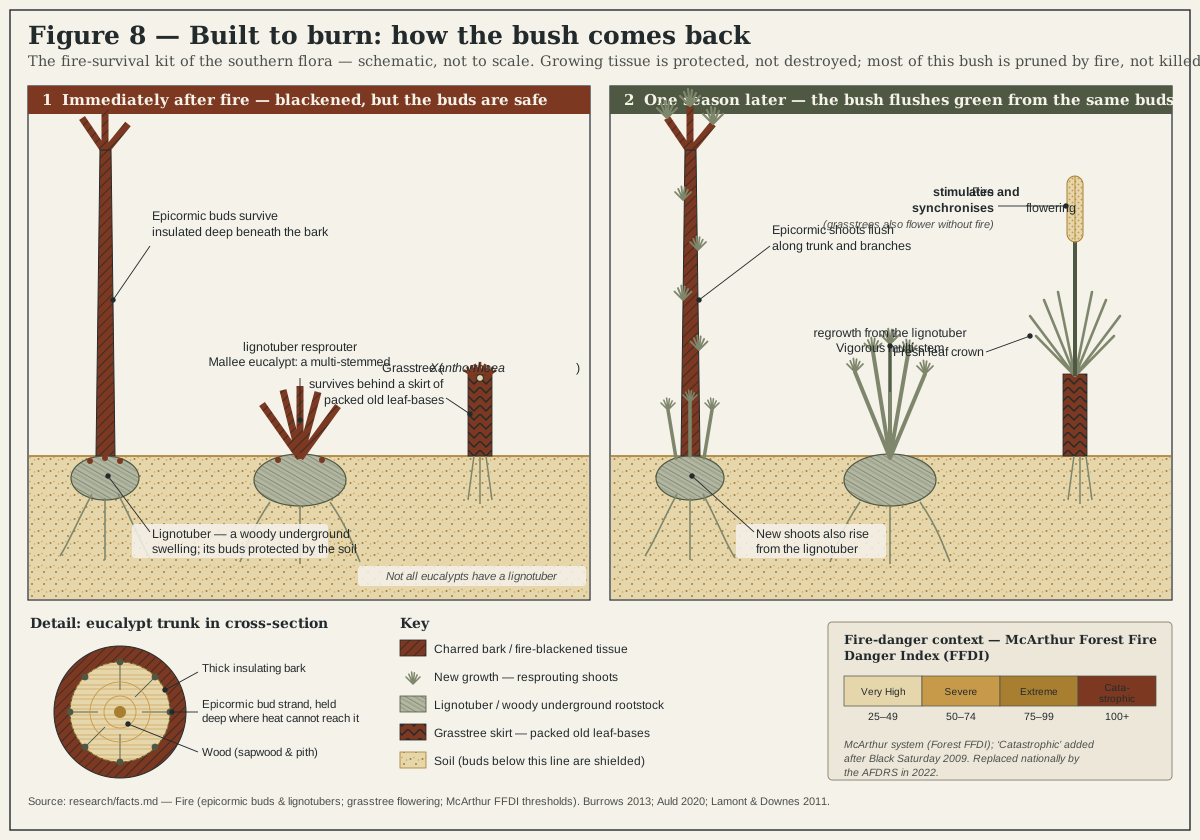
Watch a Mount Lofty forest a few weeks after a burn and the dominant impression is a slightly indecent hurry to get on with living. Eucalypts carry strands of dormant buds tucked deep beneath their insulating bark, shielded from heat that would kill an ordinary tree, and once the canopy is gone they wake almost in unison, fuzzing a blackened trunk green within weeks (Burrows 2013). Many of the same trees, and plenty of shrubs besides, keep a second account underground — a lignotuber, a bud-and-starch-packed woody swelling ready to throw up a whole new stem if everything above the soil is lost (Burrows 2013). Others do more than tolerate the flames: banksias and hakeas seal their seed inside cones only a fire’s heat will crack, and a whole guild of smaller plants keep their seed dormant until it tastes the chemistry of smoke, then germinate in a rush across the ash (Auld 2020).
None of this was lost on the people who managed this ground for tens of thousands of years before 1836, using cool, patchwork burning to keep the country open and to spend, in small change, the fuel that would otherwise feed a killing summer fire — a practice the archaeologist Rhys Jones named “fire-stick farming” in 1969 (Jones 1969). When that burning stopped, the fuel did not vanish; it banked, year on year, across a range front now dense with houses woven into flammable bush — the bind Mount Lofty land managers still wrestle with, where the dial that cuts bushfire risk and the dial that keeps fire-dependent bushland healthy turn out to be the same dial (Bardsley et al. 2015). On 14 May 2021, in the south Adelaide Park Lands at Tuthangga, that old knowledge came back into practice: a small, deliberate Kaurna cultural burn, Kaurna Kardla Parranthi, walked through the dry grass with the state environment department, the City of Adelaide and Green Adelaide (Green Adelaide 2021). Too much fire wrecks even fire-built bushland; too little merely loads the gun. This country is still working out, hillside by hillside, where between those two errors the right answer lies.
Go deeper — the mechanism & the evidence
The paradox sharpens exactly where the ranges meet the city. Bardsley et al. (2015) frame Mount Lofty wildfire risk and bushland health as outcomes of the same underlying variable — time since fire — pulling land managers two ways at once. Leave a gully unburnt for decades and its understorey piles up as continuous fuel against the houses now built into it, the classic peri-urban risk their study maps across the ranges; burn that same gully too often, before its lignotuber-resprouting shrubs and soil-stored seed have had time to rebuild their reserves, and the fire-dependent bushland itself thins out and simplifies (Burrows 2013; Auld 2020). There is no fuel-reduction setting that is simply "safe" — only a return interval chosen as a trade-off between the risk of the next catastrophic fire and the risk of exhausting the very regrowth machinery, epicormic buds and lignotubers among it, that makes this bush fire country in the first place. Reading a Mount Lofty hillside for its time-since-fire is, in that sense, reading a live risk calculation, not a static picture.
Sources for this guide · 5
Every claim here is traceable. Each citation links to its entry in the bibliography.
- Burrows, G.E. (2013). Buds, bushfires and resprouting in the eucalypts. Australian Journal of Botany 61(5):331-349. — Epicormic bud strands insulated beneath eucalypt bark, and lignotuber resprouting — the two mechanisms behind 'the bush comes back'.
- Auld, T.D. (2020). Fire and plants: how they recover. Australian Network for Plant Conservation. https://www.anpc.asn.au/wp-content/uploads/2020/01/Auld_Fire-and-plants_how-they-recover_-PDFv1a.pdf — Serotiny and smoke/heat-cued germination as further post-fire recovery strategies, alongside resprouting.
- Jones, R. (1969). Fire-stick Farming. Australian Natural History 16:224-228. — The 1969 coinage of 'fire-stick farming' for deliberate, patchwork Aboriginal landscape burning.
- Bardsley, D.K. et al. (2015). Wildfire risk, biodiversity and peri-urban planning in the Mt Lofty Ranges, South Australia. Applied Geography 63: 155–165. https://www.sciencedirect.com/science/article/abs/pii/S0143622815001563 — Wildfire risk, biodiversity and peri-urban planning in the Mount Lofty Ranges — the too-much/too-little dilemma at the range-front interface.
- Green Adelaide / City of Adelaide (2021). Cultural burning returns to Adelaide for the first time in 240 years; Kaurna cultural practise returns to the Park Lands. https://www.greenadelaide.sa.gov.au/news/cultural-burning-returns-to-adelaide-for-the-first-time-in-240-years — The 14 May 2021 Kaurna cultural burn (Kaurna Kardla Parranthi) in the Adelaide Park Lands, run with the Kaurna community, DEW, City of Adelaide and Green Adelaide.
Concepts this teaches — follow a thread
More guides like this
Part of these pathways
Test yourself →
Why do Mount Lofty land managers now light deliberate, cool-season prescribed burns instead of simply suppressing every fire that starts?
Total suppression does not remove fire risk, it stores it: fuel accumulates in the understorey of a range front now dense with houses. Bardsley et al. (2015) frame Mount Lofty wildfire risk and bushland health as outcomes of the same underlying variable, so the dial that cuts fire risk and the dial that keeps fire-dependent bushland healthy are the same dial — there is no interval that is simply 'safe', only a trade-off between the next catastrophic fire and exhausting the bush's own lignotuber-and-seed-bank recovery machinery.