A force
Reading absence
The hardest skill this book asks of you — seeing what is no longer there: the vanished mammals, a baseline that keeps sliding before anyone notices, and debts still quietly being paid.
- On the gradient
- Not a single site but a way of looking, applied the length of the whole gulf-to-range transect
Locate this place on the map →
What you'll take away
- Explain the shifting baseline — why each generation mistakes whatever survives into its own lifetime for nature's normal, undiminished state — using the documented Adelaide bilby-trapping record as the clearest case.
- Explain extinction debt — why destroying most of a habitat does not remove most of its species on the day the clearing stops, but commits some to a later, delayed loss.
- Connect both ideas to clearance and fragmentation as the mechanism that opened the account, using the Mount Lofty Ranges woodland birds as a measured, still-running example.
- Practise reading absence as detective work — recovering a true baseline from the written record (an old naturalist's sentence, a survey, a museum drawer) rather than from memory, which cannot be trusted to notice a slow loss.
Start with a sentence that should stop you cold. Writing in the 1920s, the naturalist Frederic Wood Jones recorded that rabbit-trappers working the immediate edge of Adelaide had, within living memory, pulled more bilbies from their traps than rabbits (Wood Jones 1923–1925). The greater bilby is now extinct across the whole settled south of the continent, part of a run of loss that has, in two centuries, taken more than one in ten of Australia’s roughly 270 endemic land mammals — a rate of loss no comparable country has matched (Woinarski et al. 2015). And yet nobody rang an alarm when Adelaide’s bilbies thinned out and stopped. By the time it would have mattered, no one left remembered they had ever been common enough to matter.
That is the trap this unit is named for. The fisheries scientist Daniel Pauly gave it a name in 1995 — the shifting baseline — after watching successive generations of researchers each set their idea of a “healthy” fish stock against whatever depleted remnant they personally found when they started looking, one generation’s ruin quietly becoming the next generation’s ordinary (Pauly 1995). It works exactly the same way on land. An Adelaide child today, watching a rosella work a backyard grevillea, calls that nature, and is not wrong to: they have no other yardstick, because a baseline has to be remembered to be missed, and living memory runs out fast.
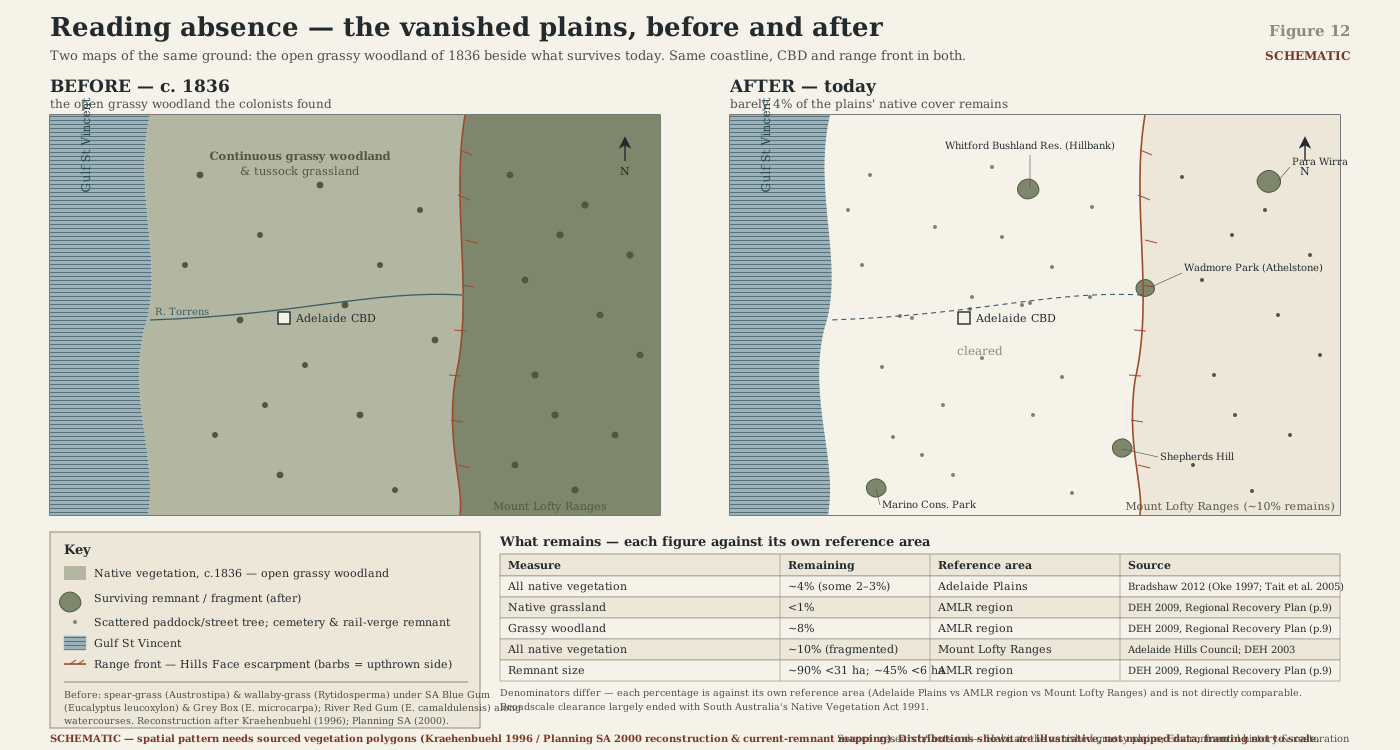
The losses are not even finished. When most of a habitat is cleared, ecologists have found, the surviving species do not all vanish on the day the bulldozers leave — some hang on in the fragments, their fate already decided, the bill merely not yet called in. This is the extinction debt (Tilman et al. 1994), and the Mount Lofty Ranges are its clearest local ledger: cleared to around a tenth of their original woodland cover, they have lost roughly ten bird species outright, more than half of what remains is still declining, and dozens more are modelled as already committed to the same fate (Szabo et al. 2011).
So reading absence is never a single glance. It is checking the naturalist’s stray sentence against the survey nobody has reopened in fifty years, and asking, of every bird still singing: is this a population, or an instalment plan.
Go deeper — the mechanism & the evidence
The debt has a counter-intuitive shape. Tilman and colleagues modelled habitat loss as a patch-occupancy problem and found that destroying most of a habitat resets the equilibrium a species is falling toward, rather than removing it outright — and the slowest to actually vanish are often not the rarest species but the ones that held the largest, most buffered populations before the clearing, simply because they have further to fall (Tilman et al. 1994). Szabo and colleagues tested this against the Mount Lofty Ranges, whose woodland cover has fallen to roughly a tenth of its original extent. Using decades of bird survey data run against habitat-loss models, they found around ten woodland species already regionally extinct, more than half of what remains still declining, and a further thirty-five to fifty species modelled as already committed to eventual regional loss even if not one more tree falls (Szabo et al. 2011). That distinction — modelled commitment versus observed loss — is the whole discipline of reading absence in miniature: a bird still singing in a gully can be a species already on a schedule, and only the survey record, compared across decades, can tell the two apart.
Sources for this guide · 5
Every claim here is traceable. Each citation links to its entry in the bibliography.
- Wood Jones, F. (1923-1925). The Mammals of South Australia. Government Printer, Adelaide. https://archive.org/details/mammalssouthaus00jone (epigraph + Ch 16 bilby source) — The rabbit-trapper anecdote — more bilbies than rabbits taken at Adelaide's edge within living memory of the 1920s.
- Pauly, D. (1995). Anecdotes and the shifting baseline syndrome of fisheries. Trends in Ecology & Evolution 10(10):430. https://doi.org/10.1016/S0169-5347(00)89171-5 — Origin of the shifting-baseline concept — each generation's depleted inheritance becomes the next generation's normal.
- Woinarski, J.C.Z., Burbidge, A.A. & Harrison, P.L. (2015). Ongoing unravelling of a continental fauna: decline and extinction of Australian mammals since European settlement. PNAS 112(15):4531-4540. https://doi.org/10.1073/pnas.1417301112 — Scale of Australia's post-settlement mammal extinctions, the loss the Adelaide bilby record is one documented instance of.
- Tilman, D., May, R.M., Lehman, C.L. & Nowak, M.A. (1994). Habitat destruction and the extinction debt. Nature 371:65-66. https://doi.org/10.1038/371065a0 — The extinction debt model — habitat destruction commits species to a future, delayed extinction.
- Szabo, J.K., Baxter, P.W.J., Vesk, P.A. & Possingham, H.P. (2011). Paying the extinction debt: woodland birds in the Mount Lofty Ranges, South Australia. Emu — Austral Ornithology 111(1): 59–70. DOI: 10.1071/MU09114. https://www.publish.csiro.au/mu/mu09114 — Mount Lofty Ranges woodland birds as a measured extinction debt still being paid.
Concepts this teaches — follow a thread
The shifting baselineThe extinction debtClearance and fragmentation (the great clearing)
More guides like this
Part of these pathways
Test yourself →
The Mount Lofty Ranges have been cleared to roughly a tenth of their original woodland cover. What does the decades-long bird survey record actually show happened to the woodland birds — and why does it count as an 'extinction debt' rather than a one-off loss?
Extinction debt means the bill for habitat loss is not settled on the day the bulldozers leave — some species hang on in fragments with their fate already decided, the loss merely not yet called in. Szabo and colleagues tested this against the Mount Lofty Ranges and found around ten woodland bird species already regionally extinct, over half of the remainder still declining, and a further thirty-five to fifty species modelled as already committed to eventual regional loss even with no further clearing (Szabo et al. 2011). That gap between modelled commitment and observed loss is what makes reading absence detective work rather than a single glance.