A species · Plant
Wattles (Acacia)
A fast, hard-seeded coloniser that pays ants in fat to bury its seed and then leaves fire, not the calendar, to decide when that seed wakes up — a cornerstone of the region's ant-sown flora.
- On the gradient
- Understorey and disturbed edges through the Mount Lofty forest and range-front scrub, thickest on freshly burnt, cleared or grazed ground
- Rock
- Range-front and Mount Lofty sclerophyll forest and woodland, on old, weathered bedrock
- Soil
- Poor, shallow, phosphorus-starved soils typical of the ranges' sclerophyll country
Locate this place on the map →
What you'll take away
- Recognise the wattle seed's two-part strategy — a hard, waterproof coat plus a fatty elaiosome — and place it among the anchor genera of the region's ant-sown (myrmecochorous) flora.
- Explain why a wattle seed can lie dormant, buried and unrotted, in the soil for decades, and why fire's heat or smoke — not the parent plant — usually decides when it germinates.
- Read a hillside gone gold with wattle a season or two after a fire, a clearing or a graded track as a disturbance signature, not a random flush of good rain.
Nothing announces the ranges’ cool season quite like a wattle in full flower — a shrub or small tree suddenly amok with fist-sized, egg-yolk puffballs of bloom, so bright it looks less like ordinary plant business than a decision someone made. Dozens of wattle species are threaded along the gulf-to-range gradient, from wiry range-front shrubs to taller gully trees, and South Australia has long claimed one of them, golden wattle, as its own emblem. Look past the flower, and past the flat, blade-like “leaf” — on a mature wattle usually not a true leaf at all but a phyllode, a flattened leaf-stalk doing a leaf’s job at a fraction of the water cost, the same sclerophyll accounting that runs through so much of this bush (Keeley et al. 2012) — and the real business of a wattle is going on in the seed.
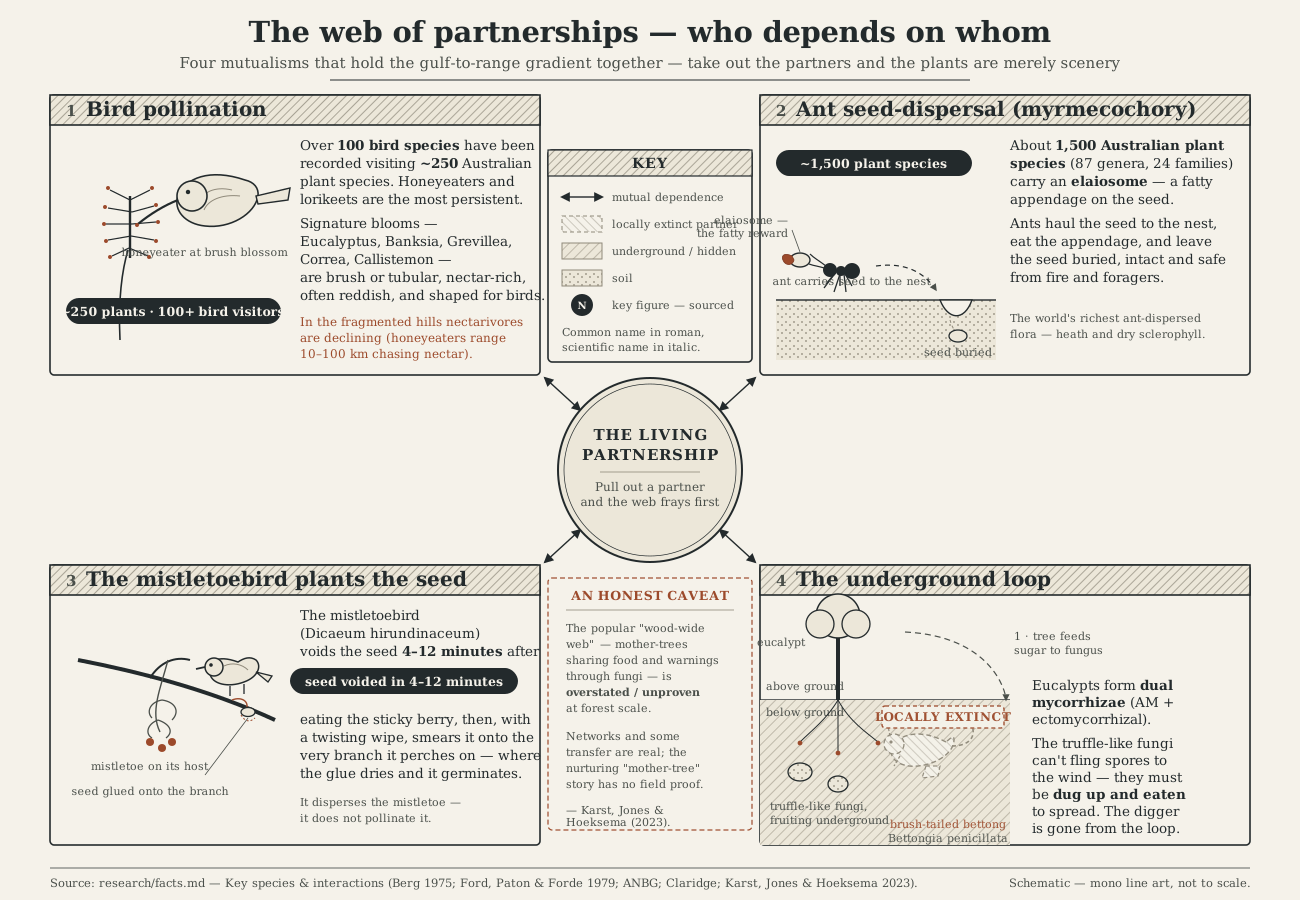
Each wattle seed is small, dark and hard-coated, and glued to one end is a small parcel of fat and protein a botanist calls an elaiosome: cheap for the plant to build, irresistible to an ant. An ant finds the fallen seed, hauls it into the nest, strips off and eats the parcel, and abandons the seed itself — now cleaned, buried and planted in exactly the rich, undisturbed soil a seedling wants. Wattles, in the pea family Fabaceae, are among the anchor genera of this trade: something like 1,500 Australian plant species have independently evolved the same fatty bribe, the richest ant-dispersed flora on the planet, and a scrubby hillside of wattle is one of its most ordinary working examples (Berg 1975).
Being carried underground by an ant matters twice over, because the same hard coat that survives an ant’s mandibles also survives fire — and fire, not the parent plant’s calendar, usually decides when a wattle seed germinates. Buried and undamaged, a seed can sit dormant for decades, until the heat of a blaze cracks its coat or smoke through the ash tells it the coast is clear, at which point seed nobody knew was there germinates across the burnt ground within weeks (Auld 2020). Wattles themselves tend to be quick, short-lived, disturbance-loving shrubs, which is why the seed bank underground matters more than any one shrub above it: a slope cleared, grazed hard or burnt through can go from bare ground to a thicket of gold-flowering wattle within a couple of seasons, running on seed that had been waiting since long before the disturbance arrived.
Read it that way, and a “weedy” flush of wattle after roadworks or a fire stops looking like an accident of good rain — an old bargain finally called in, an ant that buried a seed and a fire that, sooner or later, woke it.
Go deeper — the mechanism & the evidence
A wattle seed carries two separate survival bets stacked in the one small, dark package, and it is worth keeping them apart. The seed coat itself is hard and essentially waterproof — physical dormancy — so an ungerminated wattle seed can lie inert in the soil for decades, immune to the ordinary business of rotting, waiting on a cue that fire reliably supplies: the heat of a passing blaze cracks the coat, or the seed reads the chemical signature of smoke moving through the ash bed that follows, and germination proceeds in a rush across the burnt ground (Auld 2020). That is a different transaction from the elaiosome glued to the outside of the very same seed, which pays an ant to carry it underground in the first place — not for fire survival alone, but to escape the seed-eating birds and ants foraging on the surface (Berg 1975). The two devices work together rather than by coincidence: a seed already banked by an ant is a seed already sitting exactly where a heat- or smoke-cued dormancy mechanism needs it to be. It is why a wattle population can all but disappear above ground in a single fire season and return, thick as a hedge, the following spring — the shrubs themselves are typically short-lived, but the seed bank they leave behind can outlast them by human generations, the same soil-banked, disturbance-cued architecture the world's other Mediterranean-climate fire floras have converged on independently (Cowling et al. 1996).
Sources for this guide · 4
Every claim here is traceable. Each citation links to its entry in the bibliography.
- Berg, R.Y. (1975). Myrmecochorous plants in Australia and their dispersal by ants. Australian Journal of Botany 23(3):475-508. https://doi.org/10.1071/BT9750475 — Wattles (Fabaceae) among the elaiosome-bearing genera of Australia's ant-dispersed flora, and the carry-and-bury mechanism.
- Auld, T.D. (2020). Fire and plants: how they recover. Australian Network for Plant Conservation. https://www.anpc.asn.au/wp-content/uploads/2020/01/Auld_Fire-and-plants_how-they-recover_-PDFv1a.pdf — Hard, soil-stored seed banks and heat- or smoke-cued germination as a distinct post-fire recovery strategy.
- Cowling, R.M., Rundel, P.W., Lamont, B.B., Arroyo, M.K. & Arianoutsou, M. (1996). Plant diversity in mediterranean-climate regions. Trends in Ecology & Evolution 11(9):362-366. https://doi.org/10.1016/0169-5347(96)10044-6 — Convergent fire-survival traits — soil seed banks, smoke-cued germination — across the world's five Mediterranean-climate floras.
- Keeley, J.E., Bond, W.J., Bradstock, R.A., Pausas, J.G. & Rundel, P.W. (2012). Fire in Mediterranean Ecosystems: Ecology, Evolution and Management. Cambridge University Press. — Sclerophylly and hard-seededness as a joint response to summer drought and nutrient-poor soils.
Concepts this teaches — follow a thread
Ants as seed-planters (myrmecochory)Built to burnHard leaves (sclerophylly)
More guides like this
Adelaide rosellaBanksiaBrush-tailed bettong (woylie)Common brushtail possumGrasstree (Xanthorrhoea)Greater bilby (the lost suburbanite)
Part of these pathways
Test yourself →
A hillside north of Adelaide is cleared, grazed hard, and then burns in a summer fire. Within a couple of seasons it is thick with gold-flowering wattle where none grew before the fire. Where did all that wattle actually come from?
Each wattle seed carries a hard, waterproof coat that can sit inert and unrotted in the soil for decades, immune to germinating until fire's heat cracks it or smoke through the ash tells it the coast is clear (Auld 2020). It only sits there in the first place because an ant, paid with the seed's fatty elaiosome, carried and buried it in undisturbed soil long before the fire ever arrived (Berg 1975). So the gold flush after a burn is not new seed arriving — it is an old, ant-planted bank finally being woken up.