A species · Plant
Spear-grass & wallaby-grass
The tussock grasses that once floored the whole of the Adelaide Plains under scattered gums — now the most vanished habitat in the book, surviving as less than one per cent of its former self in scattered fenced scraps.
- On the gradient
- The vanished floor of the plains — the tussock layer of the gulf-to-range gradient's lowest, flattest, most completely cleared ground
- Rock
- Stony range-front footslopes of the eastern Mount Lofty scarp, ground too thin and steep to plough as easily as the plains below
- Soil
- Shallow, stony footslope soils at the range front; the plains proper carried the deep, easily ploughed red-brown earths that made the grassland so quick to clear
Locate this place on the map →
What you'll take away
- Identify spear-grass (Austrostipa) and wallaby-grass (Rytidosperma) by their seed heads, and distinguish them from the introduced pasture grasses that now cover almost all of the plains they once floored.
- State why the tussock grassland of the Adelaide Plains is the single most vanished ecosystem in this book — down to less than one per cent of its original extent across the Adelaide and Mount Lofty region.
- Explain why the grass floor of the plains disappeared faster and more completely than the trees standing over it, and read a fenced cemetery corner or rail verge as a clue to what is gone.
- Connect the grassland's loss to clearance-and-fragmentation and to the shifting baseline it has left behind, in which an exotic-pasture paddock now reads as ordinary.
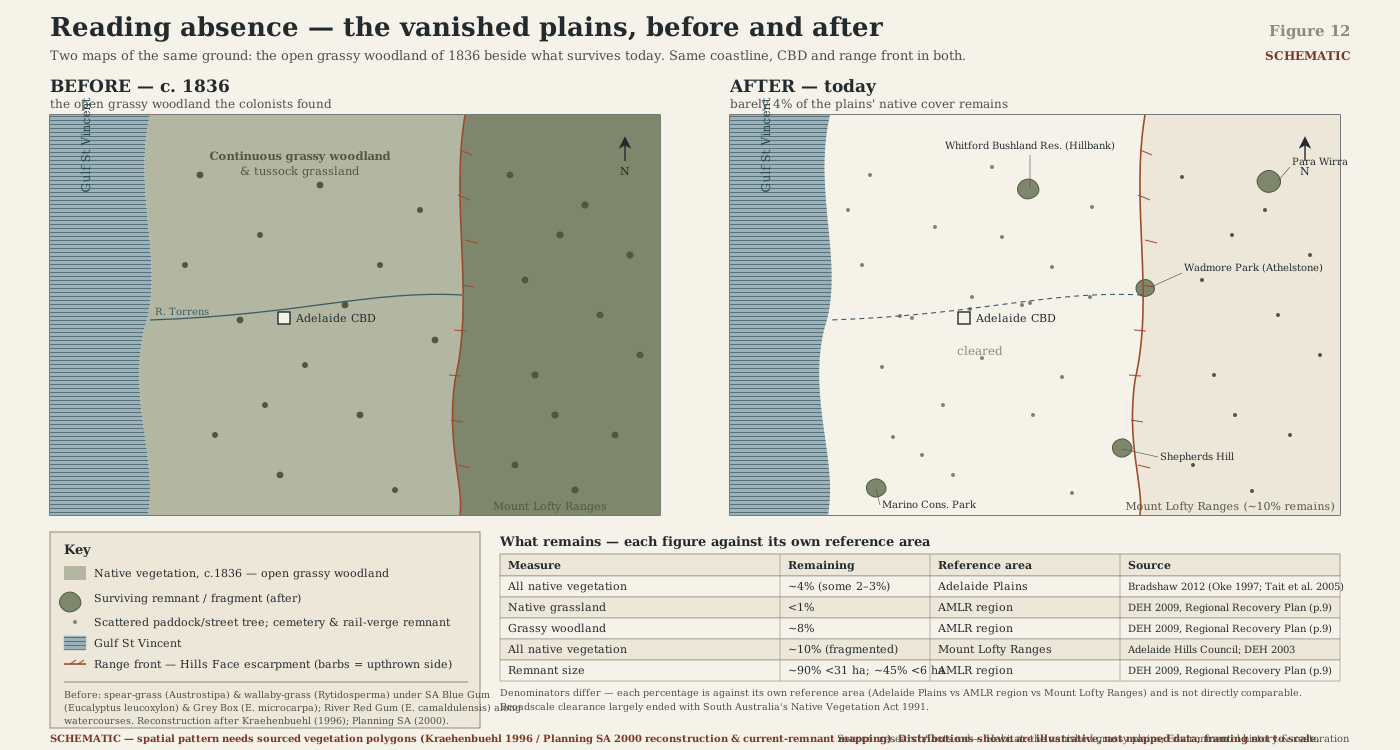
Kneel down in almost any paddock on the Adelaide Plains and the grass under your hand is, in all likelihood, a foreigner. Wild oats, veldt grass, couch — this is what “grass” means on the plains now, and it is not what grew here. To find the plant that built this country you generally have to look at its margins: a fenced cemetery corner never ploughed, a strip beside an old railway line, a stony reserve where the range front is too steep for a tractor. The tussock grassland that once floored the whole of the Adelaide Plains, under a scatter of big old gums, is now the most vanished habitat in this book — a high bar to clear.
The grass came in two main forms, and neither looks much like a lawn. Spear-grass — several species of Austrostipa, still called Stipa in older records — carries its seed on a long, twisted awn that behaves like a tiny drill bit, corkscrewing itself into wool and socks as it dries (Planning SA 2000). Wallaby-grass, Rytidosperma, is gentler: soft, pale, fluffy seed heads on wiry stems, the sort of grass early colonists likened to a hayfield rather than a wilderness. Over both, standing well apart, grew South Australian blue gum and grey box, with river red gums along the creek lines: an open, walk-through structure that looked, to the first Europeans, uncannily like a gentleman’s landscaped estate (Kraehenbuehl 1996), and owed much of that openness to generations of Kaurna land management with fire. Precisely because it looked so ready-made, it was the country taken first, and taken fastest.
The arithmetic of what is left needs two separate numbers, not one. Across the Adelaide Plains as a whole, something like four per cent of the original native vegetation survives in any form (Bradshaw 2012). The grass floor itself has fared worse again: less than one per cent of native grassland across the whole Adelaide and Mount Lofty Ranges region remains today, in small, isolated scraps, nine in ten of them smaller than thirty-one hectares (DEH 2009). The grass went first and hardest for an unglamorous reason — it was the easiest ground to plough and the most rewarding to graze flat, so while a handsome old gum might be spared for its shade, the tussock understorey beneath it was eaten out or turned under long before anyone thought to spare a paddock tree. A lone, wide-crowned gum over a paddock of introduced grass is a woodland orphan: the storey survived, the floor did not.
Because the loss ran ahead of anyone’s living memory, it also ran ahead of anyone noticing. Nobody now alive has stood in an unbroken stretch of the original tussock grassland, so a paddock of exotic pasture reads as what grass looks like: ordinary, in no need of explanation. That is how a landscape disappears without an alarm ever being raised: not in one clearing but in two centuries of nobody left to remember what “grass” used to mean here. Find a genuine remnant — spear-grass drilling its awns into your socks in early summer, wallaby-grass nodding undisturbed along a fence a plough never reached — and you are looking at one of the last honest witnesses to what this whole coastal plain once was.
Sources for this guide · 4
Every claim here is traceable. Each citation links to its entry in the bibliography.
- Kraehenbuehl, D.N. (1996). Pre-European Vegetation of Adelaide: A Survey from the Gawler River to Hallett Cove. Adelaide: Nature Conservation Society of South Australia (317 pp.). https://catalogue.nla.gov.au/catalog/1474359 — The reconstruction of the Adelaide Plains' pre-1836 tussock grassland and grassy woodland, built from surveyors' field notes precisely because almost nothing survived to walk through.
- Planning SA / Department for Environment and Heritage (2000). Forests and Woodlands of the Adelaide Plains in 1836: A Native Vegetation Planting Guide (map published Sept 1997, revised May 2000; based on D.N. Kraehenbuehl). https://data.environment.sa.gov.au/Content/Publications/Forests_Woodlands_Ad_Plains_1836.pdf — Spear-grass (Austrostipa) and wallaby-grass (Rytidosperma) as the dominant pre-European grassland species of the Adelaide Plains.
- Bradshaw, C.J.A. (2012). Little left to lose: deforestation and forest degradation in Australia since European colonization. Journal of Plant Ecology 5(1): 109–120. DOI: 10.1093/jpe/rtr038. https://doi.org/10.1093/jpe/rtr038 — ~4% of the Adelaide Plains' native vegetation surviving overall, and the 1991 Native Vegetation Act that ended broadscale clearing.
- Department for Environment and Heritage, South Australia (2009). Regional Recovery Plan for Threatened Species and Ecological Communities of Adelaide and the Mount Lofty Ranges, South Australia 2009–2014 (FIS 80034). https://cdn.environment.sa.gov.au/environment/docs/pa-rec-amlr-regional.pdf — Less than 1% of native grassland remaining across the Adelaide and Mount Lofty Ranges region, and the fragmentation of what is left into small, isolated remnants.
Concepts this teaches — follow a thread
Clearance and fragmentation (the great clearing)The shifting baseline
More guides like this
Adelaide rosellaBanksiaBrush-tailed bettong (woylie)Common brushtail possumGrasstree (Xanthorrhoea)Greater bilby (the lost suburbanite)
Part of these pathways
Test yourself →
Fewer than one in a hundred hectares of the tussock grassland that once floored the Adelaide Plains survives today, yet most people driving across the plains assume the paddock grass they see is simply what grass has always looked like here. What is going on?
Less than one per cent of native grassland survives across the whole Adelaide and Mount Lofty Ranges region, mostly in scraps under 31 hectares (DEH 2009) — a loss so old and so total that no living witness can measure a paddock of wild oats or veldt grass against what it replaced. That is a shifting baseline: each generation inherits a more depleted 'normal' and mistakes it for the original. Fragmentation describes a different problem — remnants broken into isolated patches — and it doesn't by itself explain why the loss goes unnoticed; the pasture grasses are also genuinely introduced species, not renamed natives.