A species · Other
The seed-planting ants
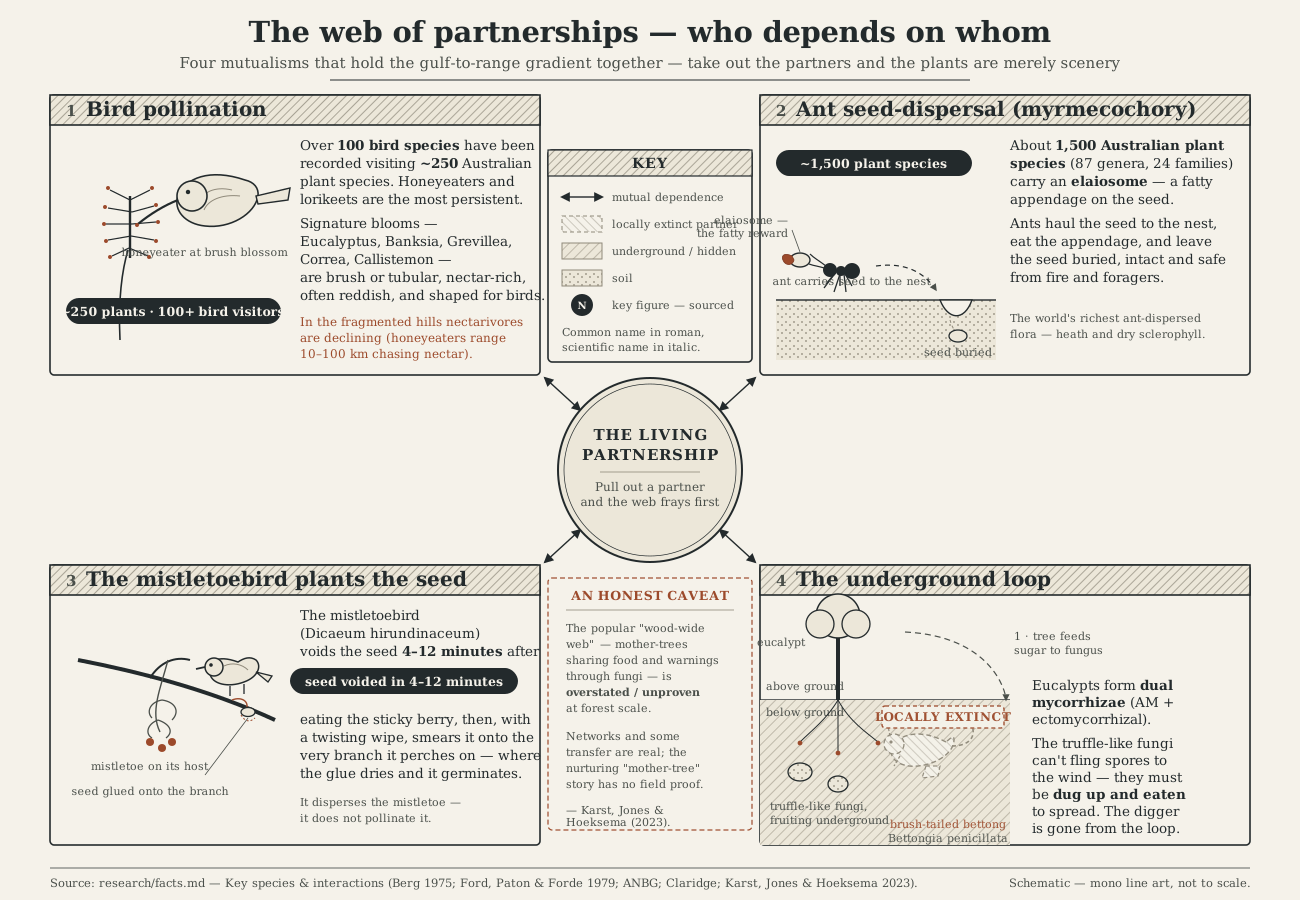
Meat ants and their smaller, less conspicuous kin hire out as gardeners for a fatty snack — hauling seed underground, eating the bribe, and leaving the seed itself planted and safe.
- On the gradient
- Underfoot through the Mount Lofty forest and scrub understorey, wherever an elaiosome-bearing shrub has just shed seed
- Rock
- Mount Lofty Ranges sclerophyll forest and scrub on old, weathered bedrock
- Soil
- Poor, phosphorus-starved soils typical of the range-front and Hills scrub
Locate this place on the map →
What you'll take away
- Recognise myrmecochory in the field — a fallen, fat-tipped seed and an ant hauling it away — and understand that the conspicuous meat ant mound is only the visible edge of a much larger guild of seed-carrying ants.
- Explain the trade at the heart of it: the plant pays in a cheap parcel of fat (the elaiosome), the ant is paid in food, and the seed itself ends up cleaned, undamaged and planted underground.
- Read a buried, ant-planted seed as insured twice over — hidden from seed-eating birds and rival ants, and, in fire country, insulated from the heat that would otherwise cook it where it fell in the open.
- Connect the ants' small underground labour to the region's poor soils, dry summers and recurring fire — three pressures that, independently, pushed some 1,500 Australian plant species to hire the same courier.
Lift a flat sandstone slab in the Adelaide Hills scrub on a warm afternoon and you will usually find the residents of this story at work: a seething, orange-brown colony of meat ants, tending eggs, hustling food back down a shaft, utterly indifferent to the daylight now falling on their nest. Meat ants are the loudest, most photographable member of a much quieter guild, because most of the seed-planting around them is done by ants nobody photographs — smaller, less aggressive foragers working the leaf litter, one seed at a time, for a reward you would need a hand lens to see.
The reward is an elaiosome: a small, oily, protein-rich parcel glued to one end of a seed, built by the plant for no other purpose than to smell irresistible to an ant. A wattle pod splits, a hakea capsule opens, a grass-tree drops its capsules, and an ant finds the fallen seed within hours, seizes it by the fatty tag and drags it, sometimes many times its own body length, back to the nest. There it strips off and eats the elaiosome and abandons the seed itself, now cleaned and buried in the loose, enriched soil of the nest chamber, precisely the bed a germinating seedling wants. Nobody arranged this as a favour to the plant; the ant is only ever collecting its own dinner. But Australia’s flora has taken up the resulting bargain more than any other on Earth — something like 1,500 native plant species, across 87 genera and 24 families, independently carry an elaiosome, concentrated above all in heath and dry sclerophyll shrubland exactly like the Mount Lofty scrub (Berg 1975).
That a hard-seeded wattle, a woody hakea and a fibrous grass-tree all hit on the same trick is the tell that this is convergent evolution rather than shared ancestry: unrelated lineages arriving independently at the same fatty bribe because they face the same three pressures. Adelaide’s ranges run on old, phosphorus-starved soil and a summer drought that punishes any seed lying exposed on bare ground, and fire, not disaster, is a routine visitor to this country (Keeley et al. 2012). A seed hauled underground by an ant escapes the seed-eating birds and rival ants working the surface, and, as a bonus its planter never intended, it is also insulated from the heat of the next fire — the same soil-stored seed bank that Mediterranean-climate floras worldwide have converged on as a way of riding out a burn (Cowling et al. 1996; Auld 2020).
None of it announces itself. There is no flower to photograph, no birdsong to place it by ear. The whole transaction happens under a rock, under leaf litter, underground, and the only sign you are ever likely to catch of it is the meat ants’ gravel mound at your feet — the visible tip of an unpaid gardening service that has been planting this scrub, one greasy seed at a time, since long before there was a track to walk in on.
Go deeper — the mechanism & the evidence
Berg's (1975) national survey is still the benchmark: something like 1,500 Australian plant species, across 87 genera and 24 families, carry an elaiosome, and Australia's ant-sown flora is the richest on Earth by a wide margin over the Mediterranean Basin, the Cape fynbos or Californian chaparral. What is easy to miss, standing in the Adelaide Hills scrub, is that this is not one plant's deal with one ant. It is a diffuse, generalist mutualism: dozens of unrelated ant species, from the big, mound-building meat ants down to small, inconspicuous ground-foragers, will all take a fallen elaiosome-bearing seed if they find one, and no single plant depends on a single named ant to get its seed planted. That looseness is part of the mutualism's strength — the plant is not gambling everything on one courier turning up — but it also means the "service" is delivered incidentally, by ants going about their own foraging, rather than by any ant evolved specifically to be a planter. The buried seed's second payoff, fire insulation, only works because Australia's fire-prone sclerophyll country already rewards a soil-stored seed bank as a recovery strategy in its own right (Auld 2020) — the ants and the fires are pulling the same seeds toward the same underground address for different reasons, a convergence layered on top of the convergence that produced elaiosomes five separate times across the Mediterranean-climate world (Cowling et al. 1996).
Sources for this guide · 4
Every claim here is traceable. Each citation links to its entry in the bibliography.
- Berg, R.Y. (1975). Myrmecochorous plants in Australia and their dispersal by ants. Australian Journal of Botany 23(3):475-508. https://doi.org/10.1071/BT9750475 — National estimate — ~1,500 Australian species (87 genera, 24 families) with elaiosomes; the ant carry-and-bury mechanism and its concentration in heath and dry sclerophyll.
- Cowling, R.M., Rundel, P.W., Lamont, B.B., Arroyo, M.K. & Arianoutsou, M. (1996). Plant diversity in mediterranean-climate regions. Trends in Ecology & Evolution 11(9):362-366. https://doi.org/10.1016/0169-5347(96)10044-6 — Convergent fire-survival traits, including soil seed banks, across the world's five Mediterranean-climate floras.
- Keeley, J.E., Bond, W.J., Bradstock, R.A., Pausas, J.G. & Rundel, P.W. (2012). Fire in Mediterranean Ecosystems: Ecology, Evolution and Management. Cambridge University Press. — Sclerophylly and hard-seededness as a joint response to summer drought and nutrient-poor soils.
- Auld, T.D. (2020). Fire and plants: how they recover. Australian Network for Plant Conservation. https://www.anpc.asn.au/wp-content/uploads/2020/01/Auld_Fire-and-plants_how-they-recover_-PDFv1a.pdf — Buried, soil-stored seed as a fire-recovery strategy distinct from resprouting or serotiny.
Concepts this teaches — follow a thread
Ants as seed-planters (myrmecochory)The same answer, five timesBuilt to burn
More guides like this
Adelaide rosellaBanksiaBrush-tailed bettong (woylie)Common brushtail possumGrasstree (Xanthorrhoea)Greater bilby (the lost suburbanite)
Part of these pathways
Test yourself →
A wattle pod splits in the Adelaide Hills scrub and an ant hauls the fallen seed away by its fatty tag. Why does that seed end up buried underground, and why does the burial matter so much in this fire-prone, poor-soil country?
The ant is never acting as a gardener — it is only ever collecting its own dinner, the fatty elaiosome glued to the seed, and it discards the seed itself once stripped in the enriched soil of the nest chamber (Berg 1975). That incidental burial does double duty: it hides the seed from surface seed-eaters, and it happens to insulate it from fire, the same soil-stored-seed strategy that Mediterranean-climate floras worldwide have converged on independently as a way of riding out a burn (Cowling et al. 1996; Auld 2020).