A species · Mammal
Short-beaked echidna
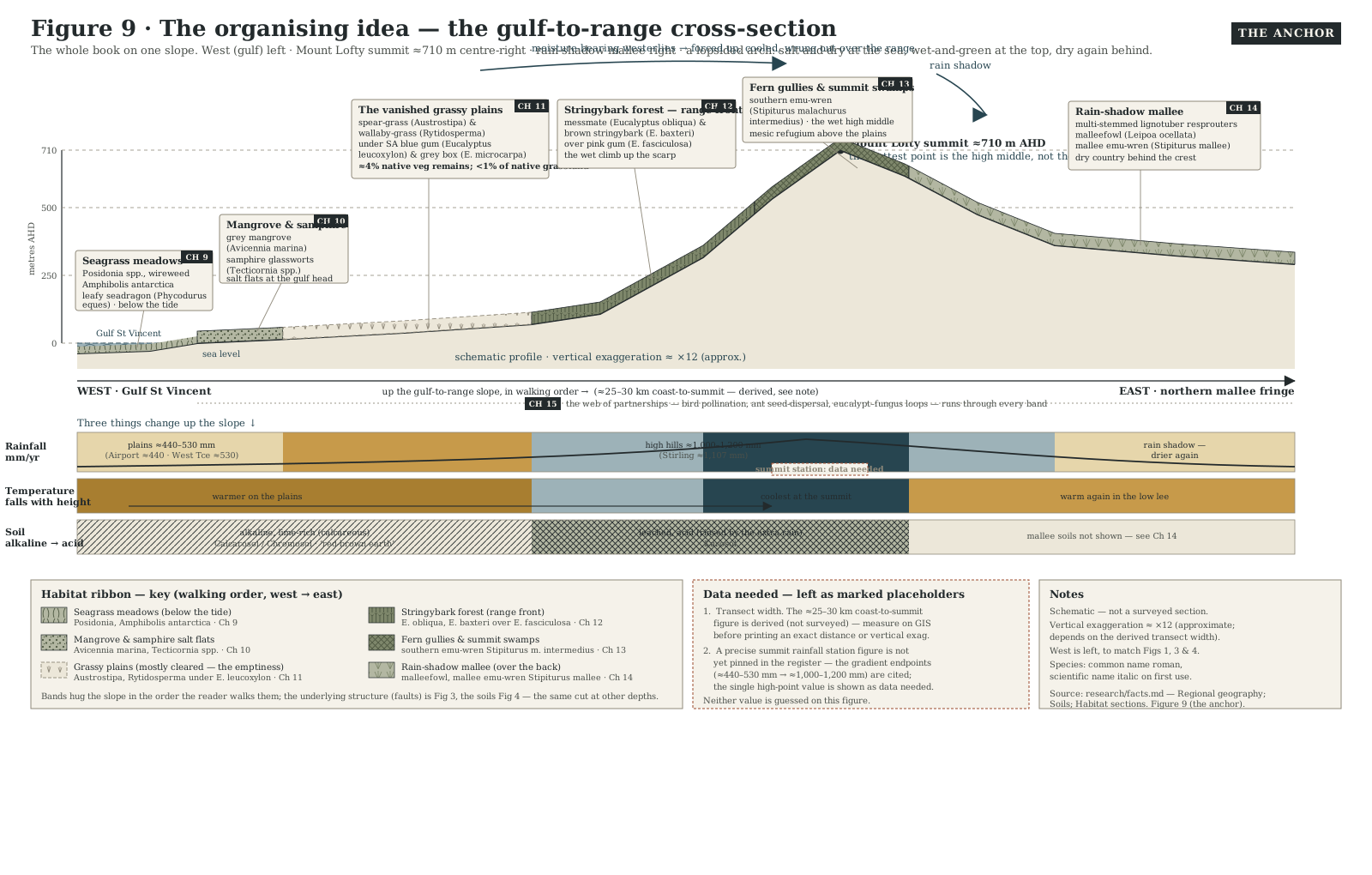
A spine-covered, egg-laying insectivore from the oldest surviving branch of the mammal family tree — and one of the very few native mammals recorded the whole length of the gulf-to-range gradient, coastal scrub to summit forest to rain-shadow mallee, through two centuries of clearing besides.
- On the gradient
- The whole gradient at once — the one native mammal genuinely recorded end to end, from the samphire coast to the summit forest to the mallee behind
- Rock
- Not tied to one formation — digs equally in Holocene dune sand, reworked plains alluvium and uplifted Mount Lofty bedrock
- Soil
- Not soil-bound — wherever ants or termites nest, from coastal dune sand to red-brown plains earths to leached ranges soils
Locate this place on the map →
What you'll take away
- Recognise echidna field sign — conical snout-pokes and torn-open ant or termite nests, and a spine-flecked, cylindrical scat — since the animal itself, a slow digger that freezes or buries itself the moment it is disturbed, is met far more often as evidence than as a sighting.
- Explain the small toolkit of traits — spines, a toothless snout built for ants and termites, and a low, flexible body temperature that lets it drop into torpor for days at a stretch — that let the echidna make a living on every rung of the gulf-to-range gradient, where most other native mammals hold to just one.
- Contrast the echidna's persistence with the region's mammal losses and with the Mount Lofty Ranges' declining habitat specialists, and read what that contrast says about which traits survive clearing and which do not.
- Use the echidna, alongside the rosella and the brushtail possum, as a live case of the shifting baseline: a genuinely common native animal that can make cleared, fragmented country look healthier than it is.
Nearly everything else in this book keeps to one rung of the gradient.
The samphire holds the salt line, the emu-wren the wet swamp, the stringybark forest the range front — each one a precise answer to its own particular ration of salt, water and lime.
The short-beaked echidna did not get that memo, and it is one of the very few native mammals in the whole region that can be found from one end of the transect to the other: rooting through the leaf litter of the coastal scrub, snuffling along a cleared paddock fence line, working a stringybark gully floor, turning up in the dry mallee behind the ranges, indifferent to which rung of the climb it happens to be standing on.
It manages this on a small, old set of tools.
An echidna is a monotreme, one of only two surviving lineages of mammal that lay eggs rather than bear live young, and everything about it reads like a design settled long before most of the rules the rest of this book runs on were written.
The spines are modified hair, keratin rather than armour, and the snout beneath them carries no teeth at all — just a long, sticky tongue that flicks deep into a torn-open ant or termite nest faster than the eye can follow.
Threatened, it does not run; it digs straight down, wedging itself into the ground until only a knuckle of spines is left showing, or curls into a ball no fox or dog much fancies its chances against.
And its body temperature runs unusually low and flexible for a mammal, a trait that lets it slide into torpor for days or even weeks at a stretch through a cold snap, a drought or the lean months after a fire, waiting out conditions that would force a fussier animal to move on or die.
None of that is a suburban work-around, the way the brushtail possum’s move from tree hollow to roof cavity is.
It is the same toolkit that has always let the echidna live anywhere ants and termites do, which in this region is everywhere, and it is very likely part of why the species has come through two centuries of land clearing and introduced foxes and cats in far better shape than the ground-dwelling mammals it shared the country with — more than one in ten of Australia’s endemic land-mammal species lost in that time, the worst such record on the planet (Woinarski et al. 2015).
The Mount Lofty Ranges’ fussier specialists are still sliding as their forest is thinned and cut into fragments too small to sustain them (Szabo et al. 2011), and the echidna’s own range has been reduced along with everyone else’s, something like nineteen-twentieths of the region’s original vegetation gone or degraded (Bradshaw 2012), but the animal itself keeps turning up, in bushland and farmland and reserve alike.
Which is exactly why it is worth a second look rather than a shrug: an ancient, genuinely native survivor, doing such an unspectacular job of it that it is easy to mistake for proof the country is fine, when it is really one exceptionally well-equipped contestant, still standing amid a great many losses (Pauly 1995).
Reading the country
Look for the echidna’s signature rather than the echidna: a conical snout-hole punched into soft ground beside a raided ant nest, a scuffed and broken termite mound, or a short, spine-flecked cylinder of scat on a bush track.
Winter is the best season to catch the animal itself abroad in daylight, when the “echidna trains” of the breeding season — one female trailed by a line of hopeful males — sometimes cross open ground in full view.
Then ask the harder question its ordinariness is built to prompt: which of the mammals that once shared that same ant nest are no longer around to compete for it.
Notes & sources
Authored for Reading the Country. General echidna natural history — monotreme egg-laying, spines as modified hair, toothless ant-and-termite diet and tongue, defensive digging-in and curling, low/flexible body temperature and torpor, and winter “echidna trains” — is stated qualitatively as standard vertebrate-zoology field-guide biology; no numeric or contested regional claim rests on it.
- Mammal-extinction backdrop. More than one in ten of Australia’s endemic land-mammal species lost since European settlement, the worst continental record on Earth, driven chiefly by land clearing and introduced foxes and cats — Woinarski, Burbidge & Harrison 2015, PNAS 112(15):4531–4540. Used here as the contrast the echidna’s persistence is read against, consistent with this register’s brushtail-possum and greater-bilby units.
- Mount Lofty specialist decline. Mount Lofty Ranges woodland-fauna decline and extinction-debt trajectory under land clearance and fragmentation — Szabo et al. 2011, Emu 111(1):59–70. ⚠ used as general contrast; no echidna-specific trend data from this paper is asserted.
- Clearance context. The scale of South Australian native-vegetation clearance and degradation the echidna’s persistence is set against — Bradshaw 2012, J. Plant Ecology 5(1):109–120.
- Shifting baseline. The mechanism by which a common, resilient species can stand in for “healthy nature” once specialists are gone — Pauly 1995, TREE 10(10):430.
Sources for this guide · 4
Every claim here is traceable. Each citation links to its entry in the bibliography.
- Woinarski, J.C.Z., Burbidge, A.A. & Harrison, P.L. (2015). Ongoing unravelling of a continental fauna: decline and extinction of Australian mammals since European settlement. PNAS 112(15):4531-4540. https://doi.org/10.1073/pnas.1417301112 — The scale and drivers of Australia's mammal-extinction record — the backdrop against which the echidna's persistence across almost its whole range stands out.
- Szabo, J.K., Baxter, P.W.J., Vesk, P.A. & Possingham, H.P. (2011). Paying the extinction debt: woodland birds in the Mount Lofty Ranges, South Australia. Emu — Austral Ornithology 111(1): 59–70. DOI: 10.1071/MU09114. https://www.publish.csiro.au/mu/mu09114 — Mount Lofty Ranges specialist-fauna decline and extinction debt under clearance and fragmentation, the contrast the echidna's persistence is read against.
- Bradshaw, C.J.A. (2012). Little left to lose: deforestation and forest degradation in Australia since European colonization. Journal of Plant Ecology 5(1): 109–120. DOI: 10.1093/jpe/rtr038. https://doi.org/10.1093/jpe/rtr038 — The scale of South Australian vegetation clearance the echidna has persisted through, across every rung of the gradient.
- Pauly, D. (1995). Anecdotes and the shifting baseline syndrome of fisheries. Trends in Ecology & Evolution 10(10):430. https://doi.org/10.1016/S0169-5347(00)89171-5 — The shifting-baseline mechanism — why a common, resilient animal can stand in for 'healthy nature' once specialists are gone.
Concepts this teaches — follow a thread
The gradient (reading ecology as a climb)Clearance and fragmentation (the great clearing)The shifting baseline
More guides like this
Adelaide rosellaBanksiaBrush-tailed bettong (woylie)Common brushtail possumGrasstree (Xanthorrhoea)Greater bilby (the lost suburbanite)
Test yourself →
The short-beaked echidna turns up right across the gulf-to-range gradient — coastal scrub, cleared paddock, range-front forest, mallee behind — while many of the region's other native mammals have vanished from most of that same ground. What is the more accurate way to read the echidna's persistence?
Spines, a toothless ant-and-termite diet available almost anywhere, and a low, flexible body temperature that allows long torpor let the echidna persist on nearly every rung of the gradient, so its ordinariness is easy to mistake for proof the country is fine. It is not: more than one in ten of Australia's endemic land-mammal species have been lost since European settlement, the worst continental record on Earth, driven chiefly by land clearing and introduced foxes and cats (Woinarski, Burbidge & Harrison 2015), and the Mount Lofty Ranges' habitat specialists are still sliding under the same pressures. The echidna is one exceptionally well-equipped survivor standing amid those losses, not a sign the ecosystem around it is intact — the shifting-baseline trap this book keeps returning to.