A species · Bird
White-fronted chat
A small, sharp-suited bird of the open samphire and saltmarsh flats, bouncing low over the crimson ground on a thin, tinkling call — proof the 'wasteland' coast has specialists of its own.
- On the gradient
- The salt threshold — open samphire and saltmarsh at the foot of the gulf-to-range gradient
- Rock
- Holocene tidal mud and estuarine sediment over the St Vincent Basin
- Soil
- Saline, sometimes waterlogged clay-loam of the open samphire flat
Locate this place on the map →
What you'll take away
- Identify the white-fronted chat by its stark black-and-white face, whirring low flight and thin, tinkling call over open samphire — and learn to look past the more famous slender-billed thornbill to the other small bird sharing its flat.
- Explain why the chat needs open, low, sometimes bare salt-ground rather than the taller samphire and mangrove nearby, reading 'saltmarsh' as several stacked habitats rather than one uniform wasteland.
- Connect the chat's fortunes to the vulnerable, listed saltmarsh community it depends on, and to the sea-level and clearance pressures already logged for the samphire coast.
Walk out onto the open samphire flats north of Adelaide and, sooner or later, something small and quick will bounce up ahead of you, flick low across the crimson ground on whirring wings, and drop back into cover with a thin, tinkling call that seems too delicate for a place this salty and hard. That is the white-fronted chat, and it is one of the few birds bold enough to live in the open rather than hide in it. The male is unmistakable once you have seen him: a face and breast of stark white, cut through by a black band like a highwayman’s mask, the rest of him grey-brown and unremarkable. The female wears the same pattern in duller, sandier tones, as female birds so often do, camouflage taking priority over show once there is a nest to sit on.
What the chat wants is not the samphire itself so much as the open, low, sometimes near-bare ground the samphire flat provides between its clumps and hummocks — short cover it can see over and run through, rich in the small invertebrates it picks off the mud and salt-crusted turf on foot rather than on the wing. That matters, because it means the “saltmarsh” is not one habitat but several folded together: the slender-billed thornbill keeps to the denser samphire itself, the mangrove holds its own set of specialists at the tide’s edge, and the chat works the open ground between and around them (Saltmarsh 2013). Three birds, three microhabitats, all packed into a flat that a passing eye would write off as a single grey-green nothing.
None of that makes the chat safe. It depends, absolutely, on the same low, salt-tolerant ground that sits on Australia’s most exposed environmental fault line — a flat built for a tide that has, for millennia, more or less held its ground (Lennon 1987) — and that ground is now retreating as the sea rises faster than the plants and the invertebrate life they support can recolonise behind it, part of the same tipping point already logged for the samphire coast’s more famous residents (Delta 2017). Clear the open flat for a road or a salt field, and the chat has nowhere else to go; it cannot move up into the mangrove or across into denser scrub, because neither is the habitat it is built for. To find one bouncing across the open ground on a summer afternoon, then, is to read two things in the one small bird: that this particular stretch of “wasteland” is still doing its job as habitat, and that the job is getting harder every year the flat keeps shrinking.
Sources for this guide · 3
Every claim here is traceable. Each citation links to its entry in the bibliography.
- Threatened Species Scientific Committee / DCCEEW (2013). Conservation Advice: Subtropical and Temperate Coastal Saltmarsh (ecological community, listed Vulnerable under the EPBC Act 1999). https://www.dcceew.gov.au/environment/biodiversity/threatened/conservation-advices/subtropical-temperate-coastal-saltmarsh — Coastal saltmarsh — the chat's core habitat — listed as a nationally Vulnerable ecological community.
- Delta Environmental Consulting (2017). Thornbills, Samphires and Saltmarsh Tipping Points. Report for the Department for Environment and Water / Eyre Peninsula NRM, South Australia. https://cdn.environment.sa.gov.au/landscape/docs/ep/thornbills-samphires-saltmarsh-tipping-points-delta-environmental-consulting-2017-rep.pdf — Gulf St Vincent samphire/saltmarsh condition and sea-level tipping points threatening the open flats the chat forages over.
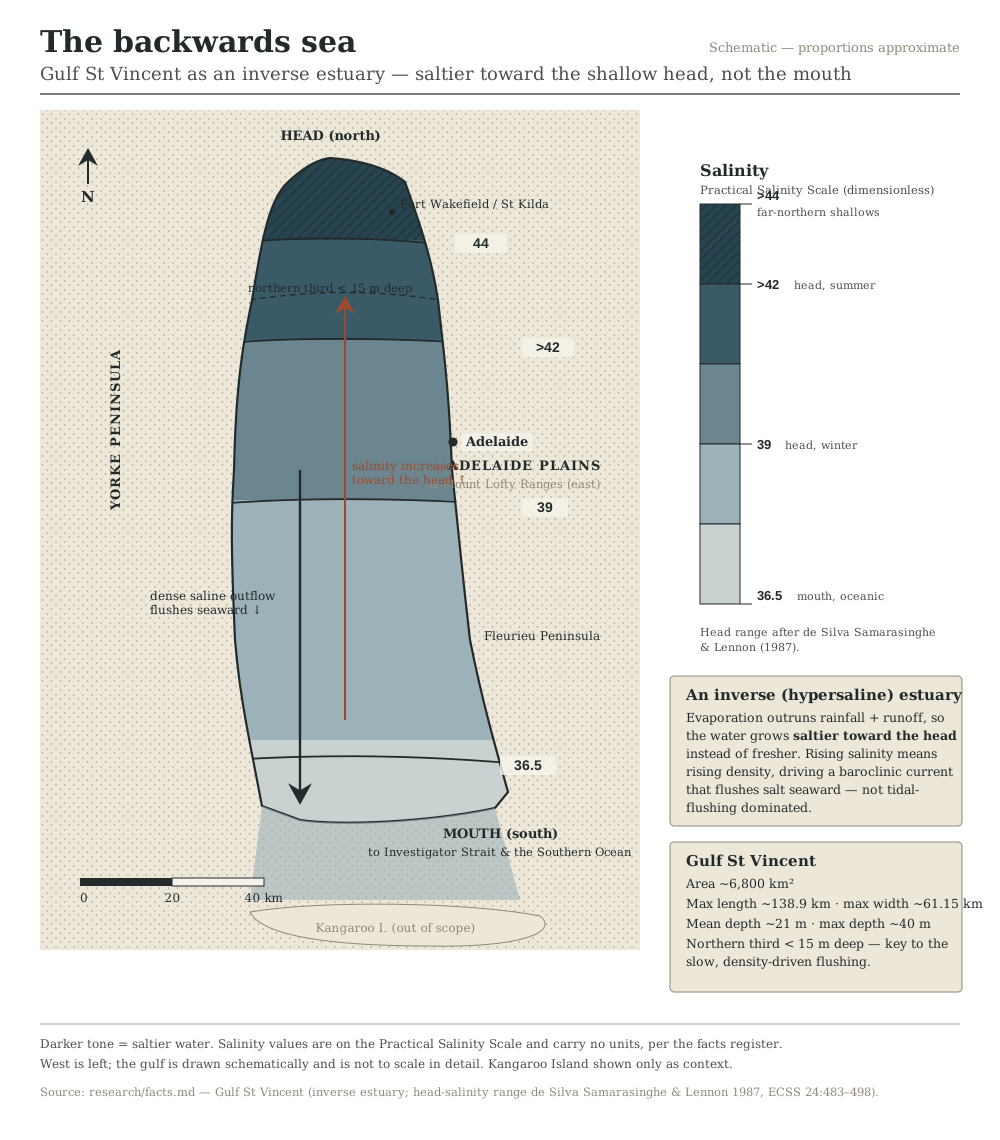
- de Silva Samarasinghe, J.R. & Lennon, G.W. (1987). Hypersalinity, flushing and transient salt-wedges in a tidal gulf — an inverse estuary. Estuarine, Coastal and Shelf Science 24(4): 483–498. https://www.sciencedirect.com/science/article/abs/pii/0272771487901296 — The hypersaline inverse-estuary gulf that sets the salt regime the chat's flat runs on.
Concepts this teaches — follow a thread
More guides like this
Adelaide rosellaBanksiaBrush-tailed bettong (woylie)Common brushtail possumGrasstree (Xanthorrhoea)Greater bilby (the lost suburbanite)
Part of these pathways
Test yourself →
The white-fronted chat shares the samphire flat with other small birds, but it is not really competing with them for the same ground. What kind of ground does the chat specifically need, and how does that set it apart from its saltmarsh neighbours?
The chat forages on foot for invertebrates over open, low, sometimes near-bare salt-ground rather than hiding in cover, which is exactly the ground the slender-billed thornbill and the mangrove's own specialists don't use. That single distinction is the point: 'saltmarsh' is not one uniform habitat but several stacked microhabitats — open flat, dense samphire, tidal mangrove edge — each read by a different bird, and the coastal saltmarsh community all three depend on is listed nationally Vulnerable (Threatened Species Scientific Committee / DCCEEW 2013).