A species · Plant
The mallee eucalypts
A gum tree that gave up on being a tree — a dozen or more thin stems sprung from one massive buried lignotuber, the visible record of a plant that has burned and resprouted for longer than anyone has been counting.
- On the gradient
- The dry lee — the farthest, driest end of the gulf-to-range gradient, beyond the rain shadow of the ranges
- Rock
- Low, evenly spaced Woorinen aeolian sand dunes over Tertiary Loxton/Parilla Sands, in the rain shadow behind the eastern Mount Lofty Ranges
- Soil
- Deep, low-nutrient, calcareous dune-and-swale sand
Locate this place on the map →
What you'll take away
- Recognise a mallee eucalypt by growth form alone — a dozen or more thin stems rising from one buried lignotuber, never a single trunk — and explain why that shape, not the species label, is the diagnostic feature.
- Distinguish the two fire-recovery mechanisms eucalypts carry — bark-insulated epicormic buds on the stems, and the deeper reserve of buds and starch in the lignotuber — and say which one a mallee falls back on when fire takes every stem at once.
- Read a mallee's multi-stemmed shape as a record, not just a habit: evidence of a plant that has been burned to the ground and grown back from underground, repeatedly, over a very long time.
Drive past a stand of mallee and your eye, trained on ordinary trees, keeps looking for the trunk.
There isn’t one.
Where a jarrah or a river red gum puts everything into a single rising column of wood, a mallee eucalypt has given up on that idea entirely and instead grows a dozen or more thin stems, all much the same size, springing together from a single woody swelling buried in the ground.
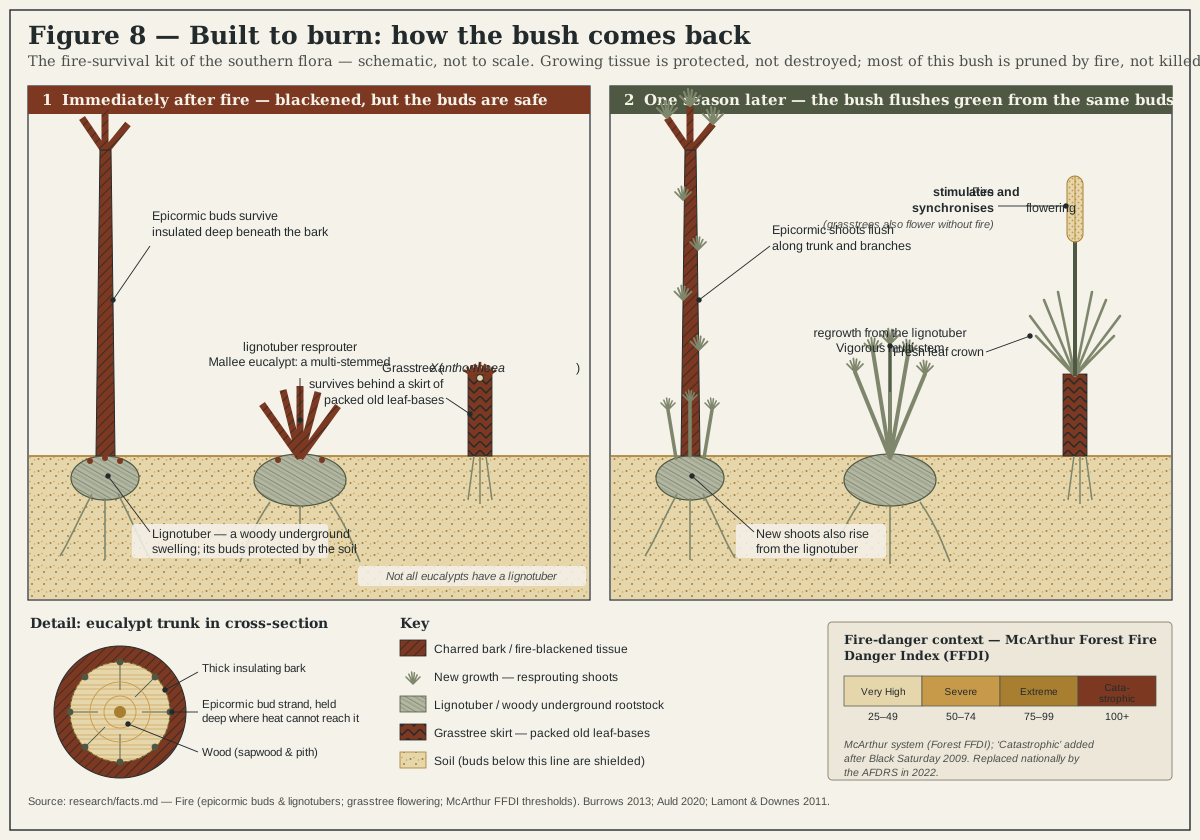
That swelling is the lignotuber, and it is doing something no ordinary trunk can do: banking a reserve of dormant buds and stored starch below the reach of heat, so that when fire burns every one of those stems to a blackened stump — as in this country it regularly does — the plant is not dead, merely pruned (Auld 2020).
Within weeks a fresh cluster of shoots breaks through the ash in a ring around the old base, and the mallee carries on as if the fire had been an inconvenience rather than a catastrophe.
Eucalypts carry two separate fire-recovery tricks.
The first is a strand of epicormic buds tucked just beneath the bark of the trunk and branches, insulated from a fire that scorches but does not kill the stem outright — the mechanism behind the “green fuzz” you see clothing a burnt trunk within a month of a fire passing through (Burrows 2013).
The second is the lignotuber itself, the deeper and more drastic account, drawn on only when the stems above ground are finished for good.
A mallee’s whole identity is built around leaning on that second account as a matter of course rather than a last resort — which is why the growth habit looks the way it does: low, shrubby, many-stemmed, not the tall single trunk of the forest eucalypts on the wet side of the ranges.
Behind Adelaide, in the rain shadow east of the Mount Lofty crest, the eucalypts doing this belong to a fairly short cast of species — red mallee, white mallee, yorrell and their relatives — standing a few metres high over a floor of saltbush or spinifex, on country too dry to grow anything taller (Foulkes & Gillen 2000).
None of that species list was guessed at through a windscreen; it was walked, one quadrat at a time, by field ecologists who counted what was there rather than assuming one grey shrub looked much like the next.
What all of them share, whatever the species name on the label, is that buried, multi-budded rootstock and the many thin stems it throws up in its place.
Stand in front of a mallee clump, and you are not looking at a young tree that never got around to growing a trunk.
You are looking at the visible record of a plant that has been burned to the ground and grown back from underground, over and over, for longer than anyone has been keeping count — a gum tree that solved the problem of living in fire country by refusing, ever again, to keep all of itself above the soil at once.
Go deeper — the mechanism & the evidence
Not every eucalypt keeps a lignotuber, and the ones that do are not all mallees - a lignotuber is a general eucalypt option, and "mallee" is simply the name for a growth form in which it becomes the plant's whole strategy (Burrows 2013). A single-trunked eucalypt with a lignotuber treats it as a reserve account, drawn on only if the crown is killed outright; a mallee spends from that account as a matter of routine, because in this rain-shadow country routine is exactly what fire is. Each stem above ground is disposable - thin, short-lived by tree standards, replaceable - while the lignotuber below, swelling year on year with stored starch and a bank of dormant buds, is the part of the plant built to last. That division of labour also explains the shape a mallee stand takes after a fire: rather than a single trunk regrowing a canopy from a blackened crown of epicormic shoots the way a tall single-stemmed eucalypt might, a burned mallee vanishes above ground almost entirely and then reappears as a fresh ring of a dozen or more stems, all the same age, all sprung from the one rootstock (Auld 2020). Walk a rain-shadow stand and count the stems in a single clump, and you are, in effect, counting a rough proxy for how hard and how often that patch has burned - though not a fire-ring count in the way tree rings work, since a lignotuber does not lay down one countable increment per fire so much as it simply gets larger and buds more freely with age (Burrows 2013). The species doing this across the rain-shadow country behind Adelaide are a fairly short list - red mallee (Eucalyptus socialis), white mallee (E. dumosa), yorrell (E. gracilis) and their relatives - and the only reason anyone can say that with confidence is that a survey walked hundreds of quadrats and wrote down, plant by plant, what was actually growing there rather than guessing from a car window (Foulkes & Gillen 2000).
Sources for this guide · 3
Every claim here is traceable. Each citation links to its entry in the bibliography.
- Burrows, G.E. (2013). Buds, bushfires and resprouting in the eucalypts. Australian Journal of Botany 61(5):331-349. — Epicormic bud strands insulated beneath eucalypt bark, as the stem-level fire-recovery mechanism.
- Auld, T.D. (2020). Fire and plants: how they recover. Australian Network for Plant Conservation. https://www.anpc.asn.au/wp-content/uploads/2020/01/Auld_Fire-and-plants_how-they-recover_-PDFv1a.pdf — The lignotuber as a second, distinct, below-ground fire-recovery strategy.
- Armstrong, D.M., Croft, S.J. & Foulkes, J.N. (2003). A Biological Survey of the Southern Mount Lofty Ranges, South Australia, 2000–2001. Department for Environment and Heritage, South Australia. https://data.environment.sa.gov.au/Content/Publications/Southern-Mount-Lofty-Ranges-BioSurvey.pdf — The dominant rain-shadow mallee eucalypts — red mallee, white mallee, yorrell — and the survey that documented them quadrat by quadrat.
Concepts this teaches — follow a thread
Built to burnHard leaves (sclerophylly)The rain shadow (the dry side of the hills)
More guides like this
Adelaide rosellaBanksiaBrush-tailed bettong (woylie)Common brushtail possumGrasstree (Xanthorrhoea)Greater bilby (the lost suburbanite)
Part of these pathways
Test yourself →
A fire sweeps through a rain-shadow mallee stand east of the Mount Lofty Ranges and kills every stem in a clump right down to ground level. What happens next?
Eucalypts carry two separate fire-recovery mechanisms, and a mallee's identity is built on leaning on the second one as routine rather than last resort. Epicormic buds under the bark can only save a stem that is scorched but not killed outright; once every stem is killed, as a mallee's routinely are, recovery falls to the lignotuber — a buried, multi-budded rootstock banking dormant buds and starch below the reach of the heat, which resprouts a fresh many-stemmed clump (Auld 2020; Burrows 2013).