A species · Bird
Mistletoebird
A tiny red-and-black bird that eats almost nothing but mistletoe berries, digests the seed in minutes, and wipes it — deliberately — onto the very branch it is sitting on: a dispersal partnership tuned to exquisite precision.
- On the gradient
- Not fixed to one rung — wherever eucalypts still stand with mistletoe in the canopy, from plains remnants to range-front forest
- Rock
- Weathered basement rock of the Mount Lofty Ranges, under eucalypt woodland and forest
- Soil
- Skeletal to texture-contrast soils typical of the range-front and hills woodland
Locate this place on the map →
What you'll take away
- Explain why the mistletoebird's short gut-passage time is not incidental but the whole mechanism of the partnership — too fast to carry a seed anywhere but the host tree it just fed in.
- Describe the bird's wiping behaviour and why it, not chance, is what plants the seed on a branch rather than dropping it to the ground.
- Read a clump of mistletoe in a eucalypt's crown as evidence of an active bird-plant transaction overhead, not as parasitic damage to write off.
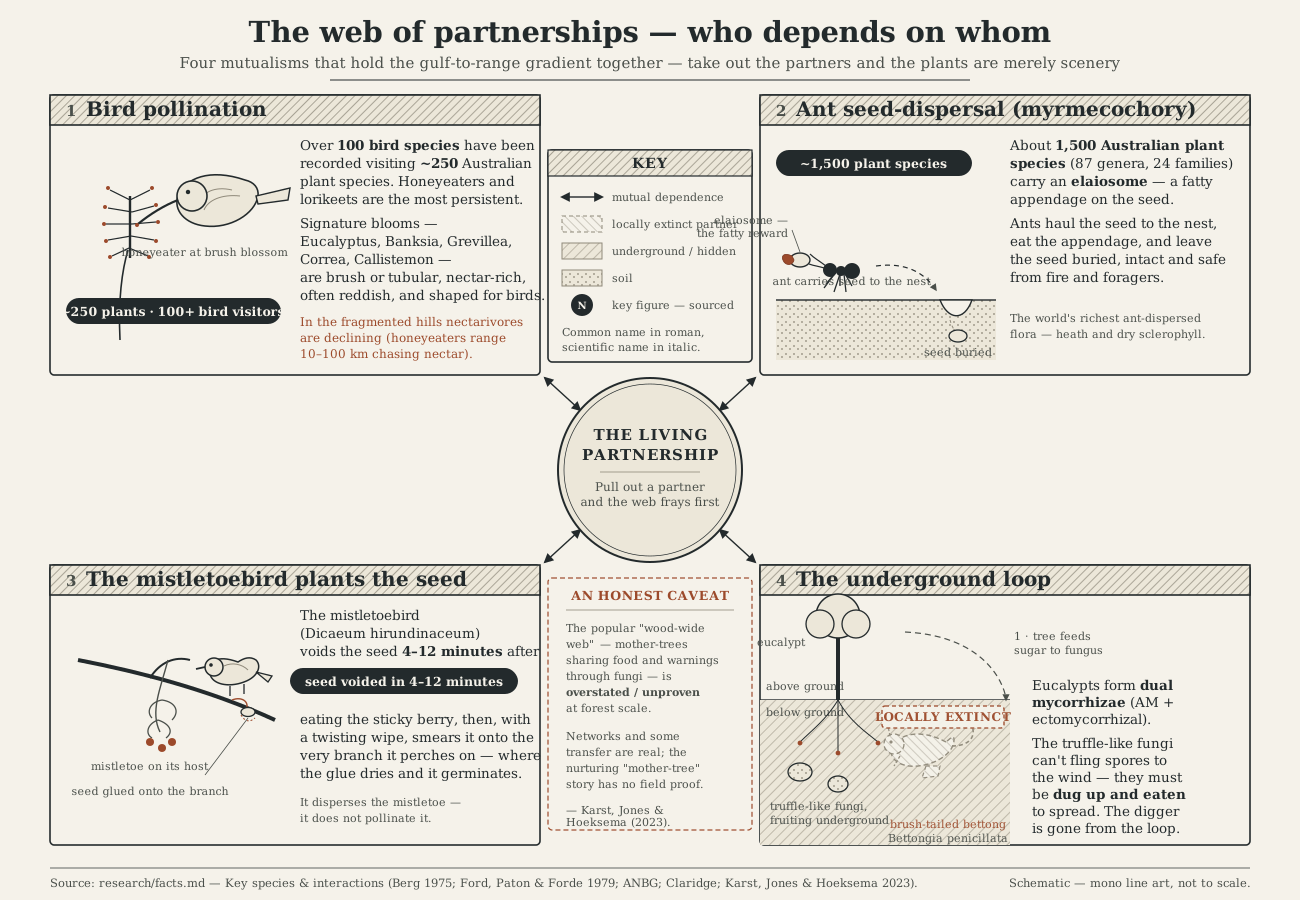
- Place the mistletoebird alongside the region's other tightly-coupled partnerships — bird pollination, ant seed-planting — as one more thread in the same web.
Look up into almost any old eucalypt around Adelaide and, sooner or later, you will find a dense, dark, oddly rounded clump hanging off one of the branches like an untidy nest.
It is not a nest. It is mistletoe, a plant that has given up on soil and taps its water and minerals straight out of the host tree’s own plumbing, and for a very long time people took one look at it and reached for the loppers.
That is a mistake, and the animal that proves it is a bird you could hold in a teaspoon.
The mistletoebird is small, glossy, black above with a wash of scarlet at the throat and rump, and it eats — for practical purposes — nothing but mistletoe berries.
Everything about it is built around that one food, and the strangest part of the design is its gut, which processes a swallowed berry and voids the seed again in as little as four to twelve minutes, one of the fastest transit times known in any fruit-eating bird.
That speed is the entire point, not a digestive quirk.
A seed held any longer would travel with the bird as it flew off to its next perch, landing wherever the bird happened to settle rather than on a living branch fit to grow it.
Instead, the mistletoebird barely has time to move: it voids the seed still sticky with the fruit’s glue, then shuffles sideways along the same branch and deliberately wipes its rear against the bark, smearing the seed onto the wood directly beneath its own feet — the very perch, more often than not, that it chose because a fruiting mistletoe was already growing there.
The glue sets, the seed sends down a root-like haustorium into the fresh wood, and a new clump of mistletoe begins its life exactly where the bird was sitting.
Multiply that arrangement across a whole continent and the numbers get startling.
Worldwide, animals from ninety-seven vertebrate families have been recorded feeding on mistletoe and fifty nesting in its dense, sheltering foliage — a single parasitic plant propping up a remarkable slice of the wider animal community, keystone in the strict ecological sense of the word (Watson 2001).
None of that would work without the mistletoebird’s peculiar plumbing.
So the next time you see that dark clump in a gum tree’s crown, resist the lopper’s instinct.
It is not a wound in the tree. It is a transaction, still being carried out overhead, one four-minute gut and one sideways shuffle at a time.
Go deeper — the mechanism & the evidence
Watson's (2001) global synthesis is the reason mistletoe's reputation has been rehabilitated among ecologists, even where foresters and gardeners still treat it as vermin. The paper's case rests on scale: mistletoe supplies nectar, fruit and unusually dense, thermally sheltering cover through the leanest months of the year, and the animal guild that has come to depend on some part of that offer — the 97 feeding families and 50 nesting families — spans birds, mammals and insects on every vegetated continent mistletoe reaches. The mistletoebird (and its Old World relatives, the flowerpeckers) sit at the sharpest point of that dependency: a genuinely specialist frugivore whose short gut retention time is a textbook adaptation, since a slower gut would scatter mistletoe seed randomly across the landscape instead of concentrating it on living branches of the right host species. The wiping behaviour completes the mechanism — targeted, not accidental, deposition, and precisely the trait that makes the bird a "planter" rather than a mere passenger for the seed. Gut-passage estimates do vary somewhat between studies (some report figures closer to twenty-five minutes rather than four to twelve), but the qualitative finding — implausibly fast, coupled to deliberate branch-wiping — is the settled part of the picture.
Sources for this guide · 1
Every claim here is traceable. Each citation links to its entry in the bibliography.
- Watson, D.M. (2001). Mistletoe - a keystone resource in forests and woodlands worldwide. Annual Review of Ecology and Systematics 32:219-249. https://doi.org/10.1146/annurev.ecolsys.32.081501.114024 — Mistletoe as a global keystone resource, and the specialist frugivore biology — including rapid gut passage — that makes birds like the mistletoebird effective planters of it.
Concepts this teaches — follow a thread
Birds that carry the pollenAnts as seed-planters (myrmecochory)
More guides like this
Adelaide rosellaBanksiaBrush-tailed bettong (woylie)Common brushtail possumGrasstree (Xanthorrhoea)Greater bilby (the lost suburbanite)
Part of these pathways
Test yourself →
A mistletoebird swallows a mistletoe berry and voids the seed again in as little as four to twelve minutes — one of the fastest gut-transit times known in any fruit-eating bird. Why is that speed the key to the whole bird–mistletoe partnership, rather than just a digestive quirk?
A seed held any longer would travel with the bird to wherever it next perched — not necessarily a living branch fit to grow it. The mistletoebird's short gut retention time, paired with its habit of wiping the sticky seed onto the bark right where it is sitting, turns chance dispersal into targeted planting: a specialist frugivore adaptation, not an incidental side-effect (Watson 2001).