A species · Plant
South Australian blue gum
A big, wide-crowned gum, scattered now across paddock and street rather than standing in the grassy woodland it once dominated — and, in winter, one of the range front's few working nectar sources for the birds that pollinate it.
- On the gradient
- The footslopes — surviving as woodland at the range front (Parra Wirra and similar reserves) but as a lone paddock or street tree on the plains below
- Rock
- Range-front footslopes over the St Vincent Basin, at the edge of the Mount Lofty uplift
- Soil
- Red-brown earths — duplex soils, sandy topsoil over a dense clay subsoil, of the plains-to-range-front transition
Locate this place on the map →
What you'll take away
- Identify South Australian blue gum (Eucalyptus leucoxylon) as the dominant tree of the Adelaide Plains' vanished grassy woodland, not an ornamental planting.
- Explain its place in the bird-pollination economy — a winter-flowering nectar source that honeyeaters and lorikeets depend on when little else is in bloom.
- Read the huge, open-branched paddock or street gum as a detective clue: a survivor of the pre-1836 woodland, not a garden escapee, and connect its isolation to the region's clearance-and-fragmentation story.
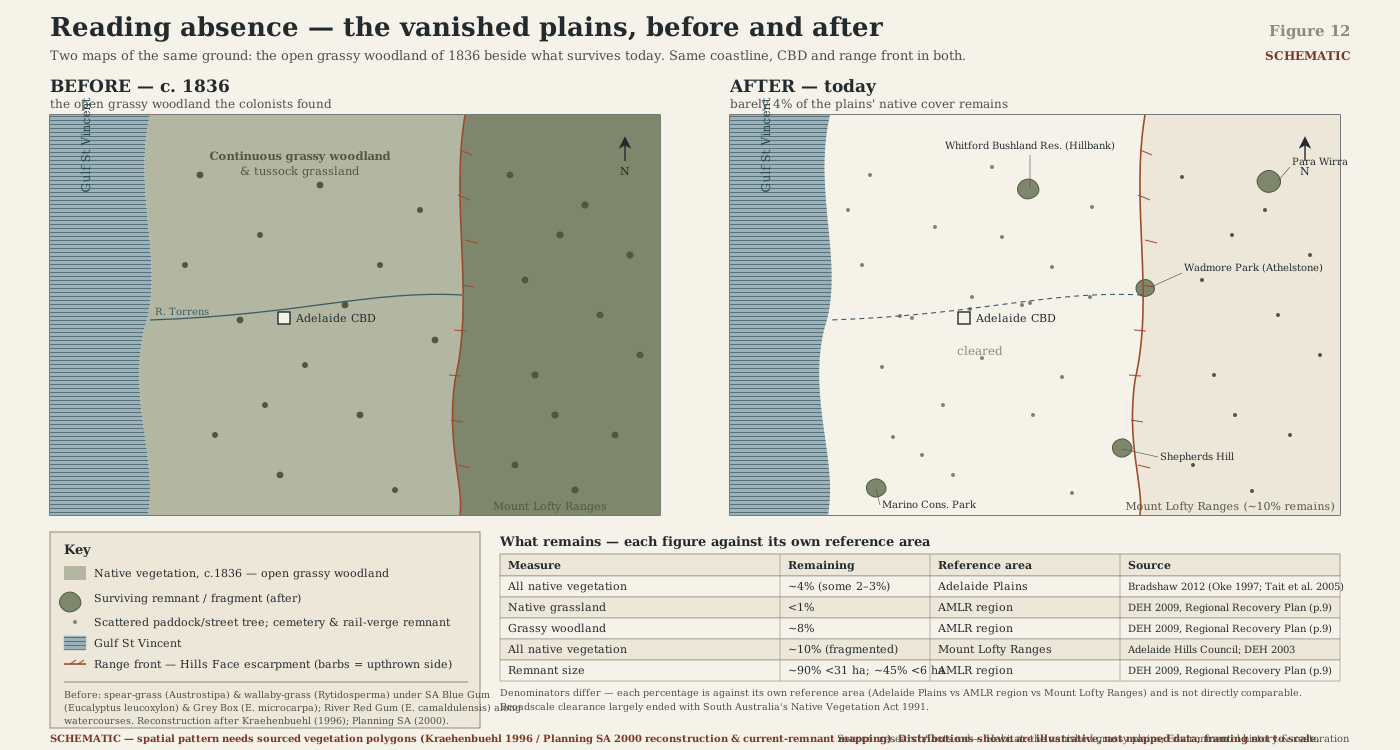
You have probably driven past one without noticing: a big, heavy-crowned gum standing entirely alone in the middle of a paddock, a school oval or a road reserve, its low branches spread wide the way a tree grows only when it has never had to compete for light. That shape is the giveaway. A tree raised in the open, jostled by nothing, tells you it once stood in spacious woodland rather than crowded forest — and on the Adelaide Plains that almost certainly makes it a South Australian blue gum, Eucalyptus leucoxylon, the single most common tree of the grassy woodland that covered this ground before 1836 (Kraehenbuehl 1996).
Blue gum and grey box stood widely spaced over a floor of spear-grass and wallaby-grass, an open, walk-through country the first colonists mistook for a landscaped park and ploughed accordingly. They were almost entirely right to be impressed and almost entirely wrong to plough it: something like four per cent of the plains’ original native vegetation survives today, and the woodland’s dominant tree now persists mostly as this — a lone paddock veteran, a street tree in a suburb that may even be named for it, rather than a community (Bradshaw 2012).
What that isolation costs is best measured in winter, when the blue gum does its real work. Southern Australia hands most of its pollination to birds rather than bees, and the region’s poorer-soil flowering plants concentrate their blooms in the cool months precisely because so little else is on offer then; honeyeaters and lorikeets move to track the bloom, feed and nest while it lasts, then drift on (Ford & Paton 1986). Blue gum’s flowering is part of that same annual clock, and researchers monitoring Mount Lofty’s woodland birds have tracked exactly this habitat — Pink Gum–Blue Gum woodland — as one of their two long-term study sites, finding well over half its bird species in decline and a slow-motion extinction debt still being paid from clearing decades old (Szabo 2011). A single flowering blue gum in an empty paddock is a nectar station stranded a very long flight from the next one — stand under one and you’ll hear as much, in the unmistakable rasp of a wattlebird overhead.
Go deeper — the mechanism & the evidence
Szabo and colleagues ran their sixteen-year Mount Lofty bird count through two habitat types, and one of them was named for this tree: Pink Gum–Blue Gum woodland, sampled alongside stringybark forest higher in the ranges (Szabo et al. 2011). That naming is not incidental. SA blue gum sits on the fertile, better-drained footslope soils that colonial clearing hit hardest, so the woodland it anchors is exactly the kind that has been cut into the smallest, most scattered pieces — and the honeyeaters that rely on its winter nectar are exactly the birds Szabo's team found sliding into decline or already regionally extinct, an "extinction debt" still being paid out decades after the clearing itself stopped. The mechanism is the bird-nectar calendar described by Ford and Paton: on the region's poorer soils, flowering concentrates in the cool months rather than summer, so nectar-feeding birds move to track it, feeding and breeding on whichever patch is in bloom before drifting to the next (Ford & Paton 1986). A single blue gum flowering hard in June, standing alone in a paddock a honeyeater must cross open, hawk-exposed ground to reach, is that calendar reduced to its most fragile possible version — one flowering tree, doing the work that a connected woodland once spread across hundreds.
Sources for this guide · 4
Every claim here is traceable. Each citation links to its entry in the bibliography.
- Kraehenbuehl, D.N. (1996). Pre-European Vegetation of Adelaide: A Survey from the Gawler River to Hallett Cove. Adelaide: Nature Conservation Society of South Australia (317 pp.). https://catalogue.nla.gov.au/catalog/1474359 — The reconstruction naming SA blue gum, with grey box, as the dominant tree of the pre-1836 Adelaide Plains grassy woodland.
- Bradshaw, C.J.A. (2012). Little left to lose: deforestation and forest degradation in Australia since European colonization. Journal of Plant Ecology 5(1): 109–120. DOI: 10.1093/jpe/rtr038. https://doi.org/10.1093/jpe/rtr038 — The ~4% figure for native vegetation remaining on the Adelaide Plains, the arithmetic behind the tree's scattered survival.
- Ford, H.A. & Paton, D.C. (eds) (1986). The Dynamic Partnership: Birds and Plants in Southern Australia. Handbooks of the Flora and Fauna of South Australia. Adelaide: Government Printer. https://www.abebooks.com/book-search/title/dynamic-partnership-birds-plants-southern-australia/author/h-a-ford-d-c-paton/ — The southern-Australian nectar calendar — winter-and-spring flowering that draws honeyeaters into the range.
- Szabo, J.K., Baxter, P.W.J., Vesk, P.A. & Possingham, H.P. (2011). Paying the extinction debt: woodland birds in the Mount Lofty Ranges, South Australia. Emu — Austral Ornithology 111(1): 59–70. DOI: 10.1071/MU09114. https://www.publish.csiro.au/mu/mu09114 — Pink Gum–Blue Gum woodland as a Mount Lofty monitoring habitat, and the extinction debt among the honeyeaters that depend on it.
Concepts this teaches — follow a thread
Clearance and fragmentation (the great clearing)Birds that carry the pollen
More guides like this
Adelaide rosellaBanksiaBrush-tailed bettong (woylie)Common brushtail possumGrasstree (Xanthorrhoea)Greater bilby (the lost suburbanite)
Part of these pathways
Test yourself →
A single South Australian blue gum stands alone in a paddock, flowering heavily in June while almost everything else nearby is dormant. Why does that one winter-flowering tree matter so much to the region's honeyeaters and lorikeets?
Southern Australia hands most of its pollination to birds rather than bees, and on poorer soils flowering concentrates in the cool months precisely because so little else is blooming then, so honeyeaters and lorikeets move to track it (Ford & Paton 1986). Blue gum's winter flowering sits on that same calendar, and long-term monitoring of exactly this habitat — Pink Gum–Blue Gum woodland in the Mount Lofty Ranges — has found more than half its bird species in decline, a slow-motion 'extinction debt' still being paid from historical clearing (Szabo et al. 2011). A lone flowering blue gum in a paddock is that fragile calendar reduced to one tree, not a birds' sole nesting site or their only possible nectar plant.